
Pestalotiopsis leaf spot of guava
Pestalotiopsis psidii
Description
Symptoms
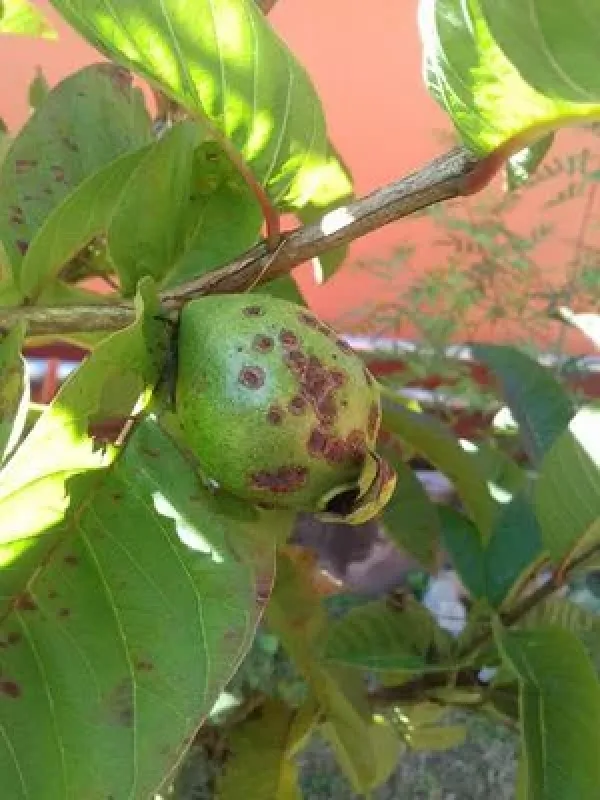
Initial symptoms appear on leaves as small brown spots, which gradually enlarge and acquire a necrotic character with a distinct margin.
On affected fruits, the disease causes the formation of deep, dry ulcers. In the center of these lesions, one can often observe the appearance of black fungal fruiting bodies resembling small cushions.
As the disease progresses, the spots on the fruits coalesce, leading to deformation and premature fruit drop. The market quality of the produce is significantly reduced to critical levels.
On young shoots, the spotting can trigger the death of terminal buds and partial drying of branches, which negatively affects the crown structure of the tree.
In high humidity conditions, a grayish mass of conidia may develop on the surface of the infected areas, indicating active sporulation of the pathogen.
Pathogen
The causative agent of this disease is the phytopathogenic fungus Pestalotiopsis psidii. This microorganism belongs to the class of deuteromycetes and specializes in infecting various parts of the common guava tree.
The fungus is capable of surviving in plant debris, infected twigs, and mummified fruits. It spreads via conidia, which are dispersed by wind, raindrops, or during routine agricultural operations.
The pathogen's life cycle is closely linked to environmental humidity. The infection enters plant tissues through stomata or mechanical damage to the epidermis, gradually colonizing the intercellular space.
A biological feature of this fungus is its ability to switch to a saprotrophic mode of life, allowing it to survive for long periods on fallen leaves while waiting for favorable infection conditions.
Numerous studies confirm that this species is specific to the genus Psidium, although it can infect other tropical crops if their immune systems are weakened by environmental stress.
Conditions for development
The main factor promoting epiphytotic development is a prolonged period of high atmospheric humidity combined with frequent rainfall during the fruit ripening stage.
The fungus develops actively at moderately high temperatures, which are optimal for the metabolism of tropical crops, making guava particularly vulnerable during rainy seasons.
Poor agricultural practices, such as the absence of sanitary pruning, create stagnant air pockets within the tree crown, increasing local humidity and promoting infection.
Excessive application of nitrogen fertilizers, which causes rapid and succulent vegetative growth, creates conditions conducive to the fast spread of the fungal infection.
Trauma to fruits caused by pests, such as fruit flies, provides a direct entry point for the pathogen into the tissues, significantly accelerating the development of the spots.
Why it matters
The primary damage lies in the massive loss of the commercial appearance of the produce. Infected guava fruits become unsuitable for sale in the fresh market due to deep necrotic lesions.
The disease significantly reduces yields by inducing flower drop and premature shedding of fruits infected at early stages of their development.
Severe foliage infection impairs photosynthetic processes, leading to general weakening of the tree, slowed growth, and a reduced immune response to other pathogens.
The chronic nature of the disease on plantations requires continuous expenditure on fungicide treatments, which significantly increases the production costs of agricultural goods.
Without control, the infection can lead to total crop loss in regions with climates favorable to the fungus, causing serious economic damage to farming enterprises.
Protection
The primary method of control is strict adherence to sanitary rules: removal and destruction of all infected plant parts, including mummified fruits and fallen leaves.
It is important to perform regular thinning pruning of the crown to improve aeration and light penetration, which reduces humidity within the tree and prevents spore germination.
Preventive spraying with copper-based fungicides is recommended in periods preceding rainy seasons to establish a protective barrier on the tissue surface.
In cases of high infection severity, broad-spectrum systemic fungicides are used, though their application must be strictly regulated with pre-harvest intervals.
Cultivating resistant guava varieties remains the most environmentally friendly and economically viable method for long-term control of this disease on plantations.
Discussion
No discussions yet — be the first.