
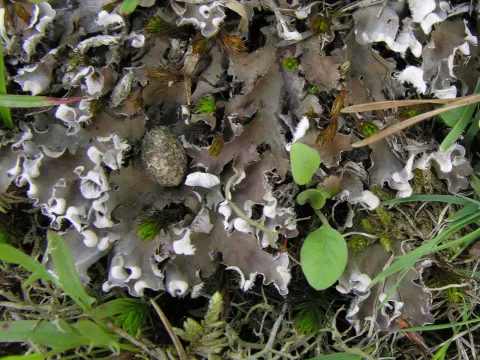
Peltigera rufescens
Peltigera rufescens
Peltigera rufescens is a species of lichen, not a plant disease, characterized by its leaf-like, lobed thallus that covers the surface of the soil.
What the section contains
Peltigera rufescens
The lobes are typically reddish-brown to grayish, often with upturned margins that exhibit a distinct, fuzzy or whitish appearance when dry.
On the underside, the lichen displays a complex system of veins and rhizoids, which allow it to anchor firmly to sandy soils, mossy patches, or rocky substrates.
It is commonly found in open, sparsely vegetated areas, including dunes, meadows, and neglected fields where competition from higher plants is low.
Unlike parasitic plant diseases, this lichen does not penetrate plant tissue, nor does it create necrotic spots or chlorosis on leaves or stems.
This organism is a symbiotic association between a fungus (mycobiont) and cyanobacteria of the genus Nostoc, which is essential for its survival.
The presence of cyanobacteria allows Peltigera rufescens to fix atmospheric nitrogen, enabling it to colonize nutrient-poor environments successfully.
It is not a phytopathogen; it does not produce toxins or enzymes that interfere with crop physiology, development, or overall plant health.
The biological life cycle of this lichen is tied to environmental conditions rather than the infection cycle of host crops common in agricultural pathology.
It exists entirely on the soil surface, acting as a pioneer species rather than an agent of plant disease or agricultural decline.
Peltigera rufescens thrives in environments characterized by high light availability, moderate humidity, and low competition from invasive grass or weeds.
It is well-adapted to extreme environmental shifts, possessing the ability to enter a dormant state during prolonged drought or temperature fluctuations.
Sandy or stony soils with low nutrient content often provide the ideal conditions for its long-term growth and stable colonization of the soil crust.
As a light-demanding species, it quickly disappears when the soil surface is shaded by dense canopy or dense foliage from taller crop plants.
Regular agricultural disturbance, such as plowing or frequent tillage, effectively prevents the establishment and spread of this lichen species in field crops.
The species causes no direct economic harm to agricultural crops, as it does not interact with the root systems or aerial parts of commercial plant varieties.
While some growers may view its presence as a sign of poor field maintenance, it does not compete for water or essential minerals with deep-rooted crops.
In grazing lands, its presence is harmless and does not affect the nutritional quality or safety of the forage consumed by livestock.
Unlike harmful pathogens, it does not spread through machinery, contaminated seeds, or wind-borne spores that could lead to widespread crop loss.
Its role in the ecosystem is primarily beneficial, as it contributes to soil crust formation and nitrogen fixation, aiding in the stabilization of raw soils.
Since Peltigera rufescens is not a crop pest or a disease, no chemical fungicides or specialized control protocols are required or recommended.
Mechanical management, including tilling, harrowing, or plowing, is sufficient to break up the lichen mats and clear the ground for sowing.
Improving soil fertility through fertilization and consistent crop management will naturally displace the lichen as faster-growing vegetation covers the soil.
Proper field maintenance that promotes a healthy density of crops will naturally limit the sunlight reaching the soil, effectively inhibiting further lichen growth.
There is no ecological or economic justification for attempting to eradicate this species through the application of heavy chemical agents or pesticides.