
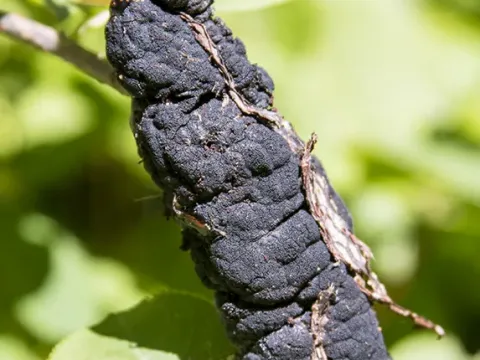
Otthia necrosis
Otthia
The causative agent of the disease is the ascomycete fungus Otthia (the most common species is Otthia spiraeae). This pathogen belongs to the group of sac fungi that lead a saprotrophic or weakly parasitic lifestyle on woody plants.
What the section contains
Otthia necrosis
The fungal life cycle involves the formation of perithecia, which develop on dead parts of the bark. Ascospores mature inside these structures and are dispersed by wind and rain, infecting weakened branches.
The fungus can persist for a long time in infected plant tissues as mycelium. The infectious reservoir accumulates in dry bark and damaged branches left behind after pruning or natural dieback.
The pathogen activates in spring when temperatures rise and humidity remains high. Spores penetrate plant tissues through micro-cracks, frost cracks, or mechanical damage.
The fungal mycelium gradually colonizes the bark and cambium, destroying plant cells and secreting toxic waste products, which leads to necrotic processes.
The main symptom of Otthia necrosis is localized dieback of bark on branches. Affected areas turn brown or dark brown and gradually dry out.
Small black bumps, which are the fruiting bodies of the fungus (perithecia), can be seen on the surface of dead bark. They are often arranged in groups or rows.
Cracking of the bark is observed in the affected areas. In cases of severe infection, circular dieback of the tissue occurs, leading to sudden wilting and drying of the entire shoot.
The wood under the bark in the infected area often darkens due to deep penetration of the fungal hyphae. Leaves on affected branches turn yellow prematurely and drop.
The disease often attacks weakened trees, so symptoms are frequently mistaken for the consequences of sunburn or frostbite, complicating visual diagnosis.
High humidity and frequent rainfall in the spring and summer promote the development of Otthia. Stagnant moisture in the tree canopy creates an ideal environment for spore germination.
Temperature plays a crucial role: the disease develops more actively at moderate temperatures, when plants weakened by the winter period do not have a strong immune response.
Poor agricultural practices, such as dense planting, reduce air circulation in the garden, creating local zones of high humidity favorable to the pathogen.
Mechanical injuries to trunks and branches caused by improper pruning, hail, or pests serve as entry points for primary infection.
Weakening of trees due to nutrient deficiencies or unfavorable soil and climatic conditions significantly increases the susceptibility of crops to this fungal disease.
Otthia causes serious harm to orchards by causing the death of individual branches and whole scaffold limbs. This reduces the total crown area and, consequently, tree productivity.
In severe cases, the disease leads to a complete loss of the tree's ability to bear fruit. Gradual tissue death disrupts sap flow, leading to the decline of the entire organism.
The infectious background in the garden increases annually if sanitary measures are not taken. This makes it impossible to obtain a quality yield and shortens the garden's lifespan.
Damage to the skeletal parts of the tree makes them brittle, which can lead to breakage under the weight of fruit or during strong winds.
The economic damage includes both the loss of harvest and the costs of additional curative and preventive treatments.
The basis of protection is timely sanitary pruning of all infected branches. It is important to remove not only the diseased parts but also include 10–15 cm of healthy tissue.
All cuts and mechanical wounds must be disinfected with copper sulfate solution or garden paint to prevent re-infection.
Preventive spraying with copper-containing fungicides in early spring (before bud burst) and late autumn significantly reduces the spore reservoir on the tree.
Maintaining a high level of agricultural technology is necessary: regular fertilization, irrigation, and protection of trunks from sunburn and frost cracks through whitewashing.
- Regular garden inspection.
- Disposal of plant debris (burning).
- Disinfection of garden tools after working with infected trees.
- Timely pest control to protect bark.