
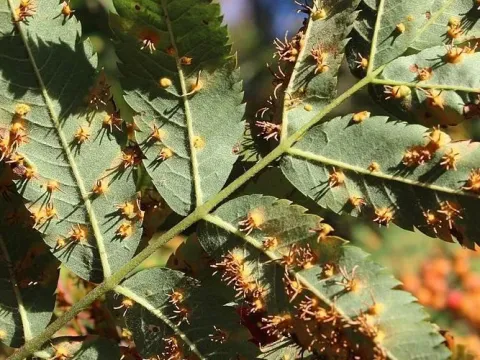
Mountain ash rust
Ochropsora ariae
The disease is caused by the heteroecious rust fungus Ochropsora ariae (sometimes referred to as Ochropsora sorbi). Like many rust fungi, this pathogen requires two taxonomically distinct hosts to complete its life cycle.
What the section contains
Mountain ash rust
The primary host, where the main stage of the disease manifests, is the mountain ash (Sorbus genus). The infection cycle involves specific spore stages that transition between the tree and the alternate host.
The alternate host for this fungus is typically plants of the Anemone family (e.g., Anemone nemorosa). The fungus survives the winter either in the tissues of the perennial host or on plant debris.
The biological cycle is complex, involving the production of aeciospores that are wind-dispersed, allowing the fungus to infect healthy tissues over significant distances.
Understanding this dual-host relationship is crucial, as the presence of anemones near mountain ash plantings directly influences the intensity of the disease outbreak in the spring.
Symptoms typically appear on the foliage of mountain ash in late spring or early summer, manifesting as distinctive spots on the upper surface of the leaves.
These spots are initially light yellow or orange, often surrounded by a characteristic reddish halo, which helps in identifying the infection early in its development.
On the underside of the leaves, directly beneath the yellow spots, dense orange or yellowish pustules known as aecia develop, containing the masses of fungal spores.
As the infection progresses, these lesions can merge, causing the leaf tissue to deform, curl, and eventually lose its ability to function, leading to chlorosis and necrosis.
- bright yellow-orange spots on the upper leaf surface;
- pustules (aecia) on the underside of leaves;
- leaf curling, distortion, and premature defoliation.
The development of Mountain ash rust is heavily dependent on cool and humid weather conditions, which are ideal for the germination of fungal spores.
Extended periods of rainfall during the leaf-out phase significantly increase the risk of infection, as moisture is required for the spores to penetrate the host tissue.
Poor air circulation within the canopy of the tree or in densely planted garden areas creates microclimates that retain high humidity, favoring the spread of the pathogen.
Proximity to Anemone species, which act as a reservoir for the rust fungus, is a major environmental factor that promotes annual recurrence of the disease.
Neglected landscapes with heavy accumulations of leaf litter provide a protected environment for the fungus to overwinter and re-infect the trees in the following season.
The primary damage caused by this disease is the reduction of the leaf surface area, which leads to a decrease in the tree's photosynthetic capacity and overall vigor.
Premature leaf drop weakens the mountain ash, depleting its energy reserves and making it more susceptible to winter damage and frost injury during the dormant season.
Reduced health status negatively affects the plant's ability to produce flowers and fruit, which is a major concern if the tree is grown for its berries.
Cumulative effects of severe annual infections result in stunted growth of twigs, a thinning of the canopy, and increased vulnerability to secondary pests and pathogens.
For ornamental trees, the loss of foliage mid-season significantly diminishes their aesthetic value, ruining the decorative appearance of the garden or landscape design.
Sanitation is a critical control measure: raking and destroying fallen leaves during autumn is essential to eliminate the primary source of the fungal inoculum.
Chemical control involving copper-based fungicides or appropriate systemic fungicides can be effective if applied during the early stages of bud break and post-flowering.
Improving cultural practices, such as thinning the canopy to promote better airflow and faster drying of leaves after rain, helps reduce the favorability of the environment for fungal growth.
If feasible, removing host plants (Anemone species) from the immediate vicinity of the mountain ash can disrupt the fungal life cycle and significantly lower infection pressure.
Maintaining tree vigor through proper fertilization and watering helps the plant develop a better immune response, allowing it to withstand the impact of the disease more effectively.