
European fruit tree canker
Neonectria ditissima
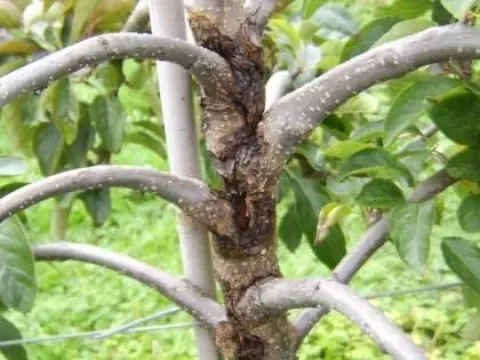
The first signs of European canker appear as small, sunken, or discolored spots on the bark. Over time, these areas become brown, and the bark begins to crack, often revealing the woody tissue underneath.
What the section contains
European fruit tree canker
As the disease progresses, the tree attempts to wall off the infection by forming callus tissue. This process results in the development of characteristic open cankers, which look like concentric ridges of callous growth surrounding an open wound.
In some cases, the cankers remain closed, forming swollen, distorted areas on the branches. These branches often become brittle and are prone to breakage, especially during storms or under the weight of fruit.
During moist conditions, small, bright red, or dark maroon fruiting bodies, known as perithecia, appear on the surface of the canker. These are the reproductive structures of the fungus that release spores to spread the infection.
Fruit infection is also common, appearing as brown, rotting spots often centered around the calyx. Infected fruit may fall prematurely or show signs of decay while in storage, contaminating other healthy fruit.
The disease is caused by the fungus Neonectria ditissima. It primarily affects apple and pear trees, although other fruit trees like cherry and plum, as well as various deciduous forest trees, can also host the pathogen.
This fungus is a wound pathogen, meaning it enters the tree through physical injuries. These can be pruning wounds, leaf scars, frost cracks, or damage caused by pests and mechanical harvesting equipment.
The pathogen thrives in the cambium layer, where it slowly kills living tissues. It remains active throughout the year, utilizing the tree's internal structures to survive and persist in the orchard environment.
Spores are dispersed primarily by rain splashes and wind. They are extremely hardy and can be released at almost any time of the year, provided temperatures are above freezing and moisture is present.
The fungus persists in the orchard by colonizing dead wood and old cankers. Without proper management, the inoculum level increases annually, making it progressively harder to control the disease.
High humidity and frequent rainfall are the most critical conditions for the spread of European canker. Rain splashes the spores onto fresh wounds, facilitating successful colonization of the host tree.
Any damage to the bark acts as an entry point for the fungus. Pruning during wet weather is particularly hazardous, as the fresh, moist cuts are highly susceptible to infection before they can heal naturally.
Orchards with high planting density and poor air circulation are more vulnerable. A stagnant, humid microclimate within the tree canopy slows down the drying process of bark wounds.
Excessive use of nitrogen fertilizers promotes succulent, late-season growth that does not harden off properly before winter. These soft tissues are more susceptible to frost cracks, which later serve as infection sites.
Environmental stress, such as waterlogging or severe drought, weakens the tree's natural defense mechanisms, making it easier for the fungus to establish itself and spread within the wood.
European canker is a devastating disease that can lead to the loss of entire branches or the death of the whole tree. It disrupts the vascular system, significantly reducing the tree's vigor and lifespan.
Structural integrity of the tree is compromised when cankers form on the trunk or main scaffold branches. This increases the risk of trees falling apart, which is a major concern for commercial fruit production.
The disease causes a substantial reduction in yield. Not only do infected trees produce less fruit, but the fruit that is produced may be of lower quality or prone to rotting during the post-harvest stage.
Economic losses are compounded by the high costs of management, including the need for labor-intensive pruning, removal of infected wood, and the application of chemical treatments.
In severe cases, the entire orchard may need to be removed prematurely. This cycle of infection forces growers to invest in resistant cultivars and intensive monitoring programs to maintain profitability.
Sanitation is the cornerstone of canker management. Infected branches should be pruned out, ensuring the cut is made well into healthy tissue, and all removed material must be burned or buried immediately.
Protective wound dressings or copper-based fungicides should be applied immediately to all cuts made during pruning. This acts as a barrier, preventing spores from landing and germinating on the exposed wood.
Cultural practices such as improving soil drainage and balancing nutrient inputs are essential for building tree resistance. Avoid heavy nitrogen applications that cause excessive, non-hardy growth.
Chemical control programs often involve applying fungicides during the leaf-fall period in autumn and at bud break in spring, as these are the most critical periods for spore release and infection.
- Use sharp tools and disinfect them frequently.
- Avoid pruning when rain is in the forecast.
- Regularly monitor the orchard for early signs of infection.
- Remove mummified fruit from trees to reduce inoculum.