
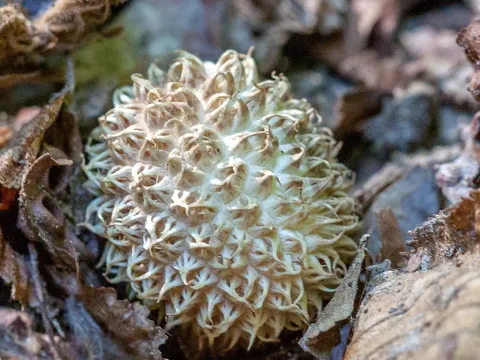
Lambinon's puffball
Lycoperdon lambinonii
Lambinon's puffball (Latin: Lycoperdon lambinonii) is a species of puffball mushroom belonging to the Agaricaceae family. In agronomy, it is primarily categorized as a saprotrophic soil fungus rather than a primary plant pathogen.
What the section contains
Lambinon's puffball
This fungus plays a significant role in the decomposition of organic matter, such as straw, leaf litter, and woody debris within the soil profile. As a basidiomycete, it acts as a nutrient recycler, though its presence can indicate specific soil conditions.
The fungus develops a mycelial network that spreads through the topsoil layer. Its reproductive structures, or fruit bodies, are characterized by small, warted surfaces that release spores into the environment through wind and water movement.
While Lycoperdon lambinonii does not directly infect living plant tissues, its ecological interactions in the rhizosphere can be complex. In high-density settings, its mass development might interfere with beneficial microbial communities.
Understanding this species is essential for precision farming, as it serves as an indicator of organic matter turnover and soil aeration status within the crop growth environment.
The proliferation of Lambinon's puffball is heavily dependent on the availability of undecomposed organic substrates. Fields with excessive surface residue or poor incorporation of manure are highly susceptible to colonization by this fungus.
Optimal development occurs at temperatures between 18°C and 24°C, accompanied by high moisture levels. This makes seasons with frequent precipitation or fields with poor drainage systems ideal hotspots for mycelial growth.
Soil structure is a critical limiting factor. Compacted soils with low aeration levels are more prone to harboring this puffball species compared to well-aerated, porous soils that facilitate rapid microbial decomposition.
The presence of this fungus is also influenced by the soil's pH levels, with a preference for neutral to slightly acidic conditions. Such environments support the reproductive phase, leading to the emergence of fruit bodies on the soil surface.
Spore dispersal is highly efficient, utilizing wind currents and irrigation systems to spread across the field. This rapid dissemination capability allows the fungus to establish itself quickly when conditions are favorable.
The primary concern regarding Lycoperdon lambinonii in agricultural fields is nutrient competition. The fungus consumes organic carbon and mineral nitrogen, which are essential for crop development and biomass accumulation.
The fungus may exert inhibitory effects on beneficial soil bacteria and mycorrhizal fungi. By dominating the root zone micro-niche, it can reduce the efficiency of the natural defense mechanisms that plants rely on to resist soil-borne diseases.
Physical blockage in the rhizosphere by the dense mycelial mats can impact water infiltration and gas exchange, leading to localized stress for seedlings during their critical growth phases.
In cases of heavy infestation, the aesthetic and physical quality of the soil is altered, which can interfere with standard cultivation practices and soil testing accuracy due to localized nutrient shifts.
While generally considered a nuisance rather than a devastating pathogen, its presence is a symptom of poor organic management, which, if ignored, can lead to lower overall field productivity and crop vigor.
Integrated management begins with sound cultural practices, specifically proper crop rotation and the thorough incorporation of crop residues into the soil. Ensuring residues are fully decomposed prevents the buildup of the puffball's food supply.
The use of well-composted organic fertilizers is crucial, as fresh manure often contains spores or provides an ideal substrate for fungal colonizers. Proper composting eliminates the risk of introducing the fungus to new fields.
Enhancing soil drainage is a primary preventive measure. Improving field grading and installing tile drainage reduces the excessive soil moisture that triggers the puffball's reproductive cycle.
Biological control, particularly the inoculation of soil with Trichoderma species, can help suppress the spread of Lycoperdon lambinonii by fostering a competitive environment where beneficial fungi prevail.
- Implement strategic tillage to enhance aeration and promote healthy soil microbial activity.
- Remove and destroy fruit bodies immediately upon detection to interrupt the spore cycle.
- Sanitize farm equipment between fields to avoid transporting fungal spores to unaffected areas.