
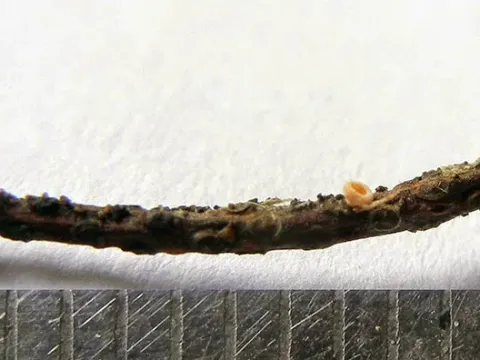
Lachnellula subtilissima
Lachnellula subtilissima
The most distinctive symptom of Lachnellula subtilissima is the appearance of small, cup-shaped fruiting bodies known as apothecia, which feature a bright orange-yellow disc with a white, hairy margin.
What the section contains
Lachnellula subtilissima
These fruiting bodies emerge directly from the bark of branches or stems, often accompanied by local necrosis and the formation of elongated, sunken lesions.
Affected branches often exhibit resinosis, where the tree produces excessive resin in response to the fungal invasion, leading to sticky, hardened crusts on the bark surface.
Needle chlorosis and early senescence on infected branches indicate a disruption in the vascular flow caused by the fungus colonizing the cambial layer of the host.
Over time, the infection can progress into open cankers, which weaken the structural integrity of the branches and can eventually lead to top-dieback or death of the entire tree.
Lachnellula subtilissima is an ascomycete fungus that acts as a facultative parasite, primarily infecting various species of conifers, including spruce, pine, and larch.
The pathogen reproduces via spores that are dispersed by wind and splashing rain, allowing it to colonize new hosts through bark wounds, frost cracks, or insect damage.
Once inside the host, the mycelium grows within the cortex and cambium, actively breaking down living tissues and inhibiting the normal development of the tree.
As a fungus, it thrives in cool, moist environments, often remaining latent in tissues until conditions become favorable for rapid vegetative growth and subsequent sporulation.
The life cycle of this pathogen is highly synchronized with the host's dormancy, often showing peak activity during mild winter periods and cool, damp spring weather.
High humidity and cool temperatures are the primary environmental drivers for the development and spread of Lachnellula subtilissima infections.
Dense, overcrowded plantation stands with poor air circulation create stagnant moisture traps that facilitate the germination of spores on the bark of susceptible trees.
Trees stressed by environmental factors, such as prolonged drought, waterlogging, or air pollution, show a significantly higher susceptibility to colonization by this fungus.
Mechanical injuries resulting from heavy snow, ice storms, or human activities during maintenance work provide optimal entry points for the fungal mycelium.
Periods of mild winter weather followed by early spring rains allow the fungus to expand its range without competition from the host's own defensive mechanisms, which remain dormant.
Lachnellula subtilissima causes significant damage to conifer forests by inducing systemic weakness, which predisposes the trees to infestations by secondary pests and wood-boring insects.
Timber quality is severely degraded as the cankers and necrosis leave permanent scars and resin pockets in the wood, making it unsuitable for high-grade construction purposes.
Nurseries often face substantial economic losses due to this disease, as it can kill young seedlings and saplings before they reach planting age.
In ornamental landscapes, the presence of the fungus ruins the aesthetic appeal of evergreen trees, causing branch dieback and thinning of the canopy.
The cumulative effect of the disease over several seasons leads to a reduction in stand productivity and increases the risk of mortality in affected woodlots.
Sanitation is the most effective management approach, involving the systematic removal and destruction of infected branches and dead trees to reduce the inoculum load in the area.
Providing optimal growing conditions, such as proper spacing and adequate nutrition, helps maintain tree vigor and enhances natural resistance against fungal infections.
Sterilizing pruning tools between cuts is essential to prevent the mechanical transmission of spores from infected to healthy trees in a landscape or nursery setting.
Chemical control using copper-based fungicides can be applied to wounds or on a preventative basis during peak infection risk periods to limit the spread of the pathogen.
Selecting and planting resistant conifer species or cultivars is the most sustainable long-term strategy to minimize the occurrence of Lachnellula subtilissima in susceptible regions.