
Icmadophila ericetorum
Icmadophila ericetorum
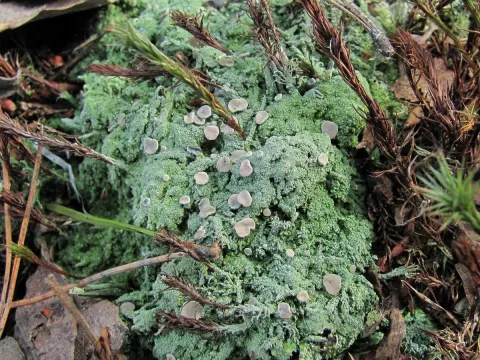
Icmadophila ericetorum presents as a bright green or bluish-green crustose thallus that forms tight patches on its substrate.
What the section contains
Icmadophila ericetorum
The surface has a granular or wart-like texture, appearing as a thin layer of biological growth on the ground.
The most diagnostic feature is the presence of distinctive pinkish or beige apothecia, which look like small, fleshy, convex discs.
These structures are commonly found on damp peat, rotting logs, or acidic soil surfaces where competition from higher plants is low.
Under humid conditions, the thallus becomes vibrant and highly visible, distinguishing it from surrounding mosses or organic debris.
It is not a plant pathogen but a lichen, a symbiotic organism consisting of a fungal partner and an algal partner.
The fungal component is part of the order Baeomycetales, which is specialized for living on damp, acidic substrates rather than infecting hosts.
It does not possess the mechanisms to parasitize living crops or extract nutrients from the internal tissues of agricultural plants.
Its biology is centered on slow decomposition and colonization of exposed surfaces rather than active pathogenic growth.
Agronomically, it is often misidentified as a fungal disease due to its external appearance on soil and plant remnants.
The primary driver for its development is high moisture content, making it a reliable indicator of waterlogged or poorly drained land.
It thrives in acidic environments, commonly appearing on peatlands or in areas with stagnant surface water.
Stable, moist conditions with limited temperature fluctuations are essential for the survival and expansion of its colonies.
It prefers acidic substrates where the soil pH is low, often found in boreal or temperate forest edges and marshy field margins.
Lack of frequent soil disturbance and reduced competition from agricultural crops favor its establishment in specific zones.
Icmadophila ericetorum causes no direct harm to crops, as it does not parasitize living plant organs or cause metabolic interference.
The indirect risk is linked to its role as an indicator of poor soil health, particularly excess moisture and high acidity.
Heavy growth on the soil surface can potentially indicate compaction or structural degradation that restricts root respiration.
In cases of thick crust formation on nursery beds, it might pose minor physical challenges to seed germination by sealing the soil surface.
There is no evidence of phytotoxic effects, and its presence should be viewed as a signal to improve soil drainage and pH levels.
Control strategies should focus on environmental modification rather than chemical intervention, as fungicides are ineffective against lichens.
Improving field drainage is the most effective way to eliminate the moist habitat that this organism requires for growth.
Liming the soil to adjust pH levels will create an unfavorable environment for this acidophilic species.
Deep plowing and regular soil tillage disrupt the surface crusts and prevent the lichen from recolonizing the area.
Removing decaying organic matter, such as old logs and dense plant debris, reduces the available substrate for its development.