
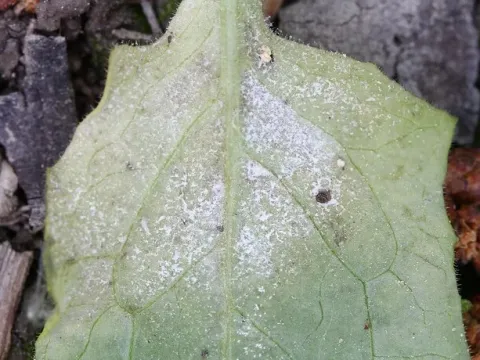
Downy mildew of winter cress
Hyaloperonospora barbareae
The first symptoms of downy mildew appear as light yellow or chlorotic spots on the upper side of the leaves, often limited by leaf veins.
What the section contains
Downy mildew of winter cress
On the underside of the leaf, a grayish or violet-gray fuzzy growth appears, which corresponds to the sporulation of the pathogen.
Under high humidity, these lesions expand rapidly, merging into large necrotic patches that eventually cause leaves to yellow and wither prematurely.
Stems and floral stalks may also show signs of infection, leading to deformation and stunted growth in severe cases.
Young seedlings are particularly vulnerable, with heavy infection leading to damping-off and reduced crop density across the field.
The causal agent is the obligate parasite Hyaloperonospora barbareae, a member of the Oomycete class within the Peronosporaceae family.
The pathogen survives in the soil in the form of oospores, which are highly resistant to adverse environmental conditions and can remain viable for several years.
During the growing season, the fungus spreads via conidia, which are dispersed by wind, rain splashes, or insects to healthy plant tissues.
The pathogen is highly specific to the Brassicaceae family, primarily affecting winter cress (Barbarea spp.) and related weed species.
The lifecycle is strictly dependent on moisture; liquid water on the leaf surface is required for zoospore germination and host tissue invasion.
The disease thrives in temperate climates with optimal temperatures ranging from +12°C to +18°C (54°F - 64°F).
High relative humidity, exceeding 80%, is a critical environmental trigger that facilitates rapid spore production and infection.
Frequent precipitation, dense fogs, and heavy morning dews provide the necessary moisture for the rapid spread of the disease within the canopy.
Overcrowded or dense crop stands hinder air circulation, allowing the leaf surface to remain wet for longer periods, thus favoring the pathogen.
Failure to rotate crops and the presence of infected plant debris in the soil are the primary drivers for disease accumulation in agricultural fields.
The primary damage is caused by the reduction of the photosynthetic leaf area, which severely limits the plant's ability to produce energy.
Plants affected by downy mildew suffer from impaired growth, resulting in decreased biomass and significant yield losses in commercial crops.
In cases of early-season infection, the reduction in plant stand density can lead to total crop failure in heavily infested patches.
The disease also affects the quality of the harvested produce, including lower oil content and reduced seed vigor.
Furthermore, infected plants are physiologically weakened and show increased susceptibility to secondary infections and opportunistic pests.
The most effective strategy is a sound crop rotation plan that excludes Brassicaceae species for at least 3 years to break the pathogen's lifecycle.
Weed management, particularly targeting wild cruciferous weeds, is essential to remove reservoirs of inoculum from the vicinity of the fields.
Planting high-quality, treated seed is a critical preventative measure against seed-borne inoculum and early seedling infection.
Balanced fertilization, especially the application of phosphorus and potassium, helps strengthen the host plant’s natural resistance mechanisms.
- Deep plowing to incorporate and decompose infected plant residues.
- Spatial isolation of new fields from areas with a history of the disease.
- Fungicide applications when environmental conditions favor disease outbreaks.