
Fulgensia
Fulgensia
Fulgensia is a genus of crustose lichens, often misinterpreted as a plant disease. It is a symbiotic organism consisting of a fungal partner (mycobiont) and an algal partner (photobiont).
What the section contains
Fulgensia
This organism is strictly an epiphyte, meaning it lives on the surface of tree bark without penetrating or extracting nutrients from the living tissues of the host plant.
Unlike parasitic fungi, Fulgensia does not secrete enzymes that degrade wood or cause necrosis; its impact is purely physical and related to its presence on the surface.
The biology of the lichen relies on slow metabolic processes, making it highly dependent on environmental stability and clean air rather than active colonization strategies.
In phytopathology, it is classified as a biological indicator rather than an infectious pathogen, though it is often managed due to its potential to harbor other pests.
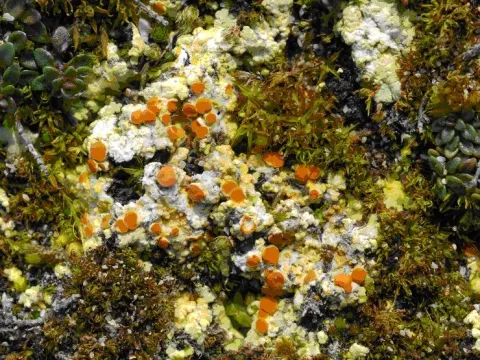
The primary symptom of Fulgensia is the appearance of vibrant yellow to orange crust-like patches on the bark of tree trunks and branches.
The thallus of the lichen is firmly attached to the bark, exhibiting a granular or squamulose structure that does not peel off easily.
These patches can grow over several years, expanding into larger colonies that cover significant portions of the bark surface.
During wet weather, the colors of the lichen become more intense, making the patches stand out against the grey or brown color of the tree bark.
The presence of the lichen often masks the texture of the bark, which can make early detection of actual tree diseases more difficult for growers.
Fulgensia thrives in areas with clean, unpolluted air, as it is highly sensitive to sulfur dioxide and other industrial atmospheric contaminants.
Adequate light exposure is critical; therefore, the lichen is most frequently observed on well-lit branches, south-facing sides of trunks, or in thinning canopies.
High relative humidity and consistent moisture are required for its growth and spore dispersal, explaining its prevalence near water bodies or in foggy climates.
Older trees with rougher, more weathered bark provide a better substrate for the lichen to anchor itself compared to smooth, young trees.
Neglected orchards or trees with slow growth rates are primary candidates for colonization, as they offer stable, undisturbed surfaces for lichen development.
The presence of dense lichen cover can slightly impede the bark's ability to undergo gas exchange, potentially stressing the tree over a prolonged period.
Fulgensia serves as an ideal micro-habitat for various orchard pests, including mites and insect larvae, providing them with shelter from predators.
The lichen surface acts as a trap for debris and moisture, which can increase the risk of wood cracking or fungal rot during freezing winter months.
Large colonies are aesthetically displeasing and can lower the commercial value of nursery stock or ornamental trees in landscapes.
The primary indirect risk is that the lichen hides underlying symptoms of genuine plant diseases, delaying necessary interventions and treatments.
Mechanical removal using soft brushes or plastic scrapers during the dormant season is the most straightforward way to manage Fulgensia.
Application of copper-based fungicides, such as Bordeaux mixture, during the tree's dormancy effectively kills lichen colonies and prevents their re-establishment.
- Regular pruning to increase airflow and light penetration.
- Whitewashing trunks with lime and copper sulfate solutions.
- Routine sanitation of the orchard to remove heavily infected dead wood.
- Applying systemic fertilizers to improve the tree's overall vigor.
- Monitoring trees for underlying issues obscured by the lichen.
It is essential to avoid using harsh tools that could wound the bark, as any opening can lead to more serious fungal or bacterial infections.
Consistent orchard management practices, including pruning and balancing tree health, naturally limit the occurrence of lichen colonies.