
Fulgensia fulgens
Fulgensia fulgens
Description
Symptoms
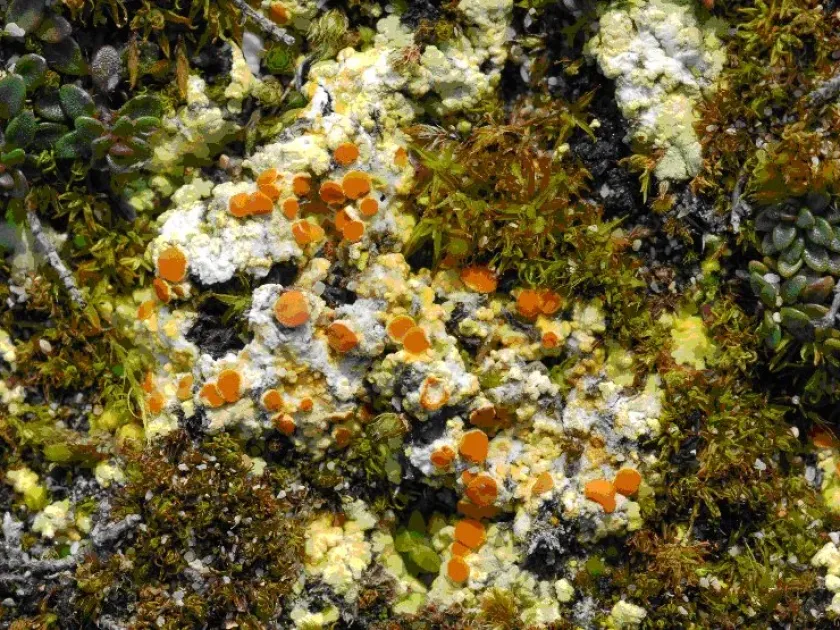
Fulgensia fulgens is a crustose lichen known for forming vivid yellow or orange patches on the soil surface, easily identifiable by its bright color.
The thallus is composed of small, tightly packed squamules that adhere closely to the substrate, creating a crust-like appearance.
Apothecia, which appear as small, often immersed or sessile discs, are usually visible on the surface of the lichen and serve as reproductive structures.
The intensity of the yellow pigment may vary depending on light exposure and moisture levels, but remains the primary diagnostic feature of the species.
This lichen is typically found in open, sparsely vegetated areas, colonizing habitats where bare soil is available and light penetration is high.
Pathogen
It is important to clarify that Fulgensia fulgens is not a plant pathogen; it is a soil-dwelling lichen, not an infectious disease agent.
The organism belongs to the Teloschistaceae family and survives through a symbiotic relationship between a fungus and green algae.
In agricultural contexts, it is often mistaken for a disease, but its presence is purely ecological and does not involve parasitic interactions with crops.
The species grows very slowly and lacks the metabolic mechanisms to invade or damage the tissues of higher plants.
It acts as a primary colonizer in natural ecosystems but holds no biological potential to infect or harm agricultural production systems.
Conditions for development
Fulgensia fulgens requires well-lit environments, as the green algae within its thallus depend on high solar radiation to perform photosynthesis.
The species thrives on alkaline or calcareous soils, preferring substrates with high mineral content where competition from vascular plants is low.
This lichen exhibits remarkable resilience to drought, capable of entering a dormant state during dry periods to survive environmental stress.
Disturbances in the soil surface, such as erosion or land clearing, provide the necessary niches for the spores of this lichen to germinate.
Intensive farming practices and regular soil tillage are generally hostile to this lichen, preventing its long-term establishment in cultivated fields.
Why it matters
Fulgensia fulgens poses no direct threat to agricultural crops and does not impact the yield or health of cultivated plants.
Its presence in a field can function as a biological indicator, suggesting low soil fertility or a lack of recent agricultural intervention.
On pasture lands, an abundance of such lichens can indicate soil degradation caused by overgrazing and the loss of healthy vegetation cover.
While it may occupy space on the ground, it does not exert any competitive pressure on healthy, vigorously growing crop populations.
The overall impact of this organism on agriculture is negligible, serving primarily as a witness to the environmental history of the land.
Protection
No specific control measures or fungicides are required for Fulgensia fulgens as it does not constitute a plant disease or pest.
Effective management involves standard agronomic practices, such as proper fertilization and regular soil cultivation to support healthy plant growth.
Improving the density of grass cover in pastures will naturally suppress the lichen by creating an environment unfavorable for its development.
Implementing anti-erosion measures is beneficial if the presence of the lichen is linked to soil instability or significant land degradation.
Mechanical removal is rarely necessary, as the lichen naturally recedes once the soil environment is optimized for higher plant productivity.
Discussion
No discussions yet — be the first.