
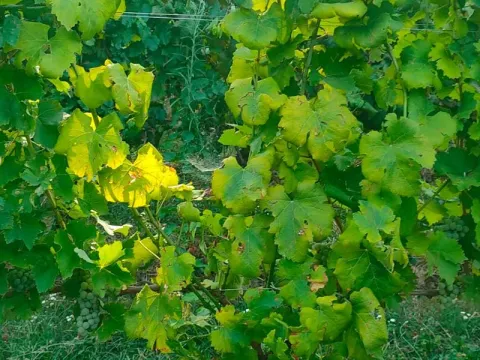
Grapevine flavescence dorée
Grapevine flavescence
Symptoms of flavescence dorée typically appear in early summer, characterized by the curling of leaves into a triangular or tubular shape. Foliage on white varieties turns a distinctive golden-yellow, while red varieties exhibit reddish or purple hues.
What the section contains
Grapevine flavescence dorée
A major diagnostic sign is the poor maturation of shoots, which remain green and succulent into late autumn. These immature shoots are highly susceptible to frost damage during winter, which severely weakens or kills the vine.
Flower clusters and grapes often drop prematurely from infected vines. Any remaining berries fail to ripen properly, becoming shriveled, bitter, and entirely unsuitable for winemaking or fresh consumption.
The infection usually progresses from localized spots to the entire vine over several years. As the disease advances, the vine exhibits general decline, reduced growth vigor, and eventually, total loss of productivity.
Early symptoms may be confused with other disorders, but the specific combination of leaf curling and the failure of shoot lignification is a strong indicator of the presence of this phytoplasma.
The causative agent is a phytoplasma known as Grapevine flavescence dorée. This obligate parasite resides within the sieve tubes (phloem) of the vine, effectively disrupting the plant's nutrient transport system.
The primary vector for the pathogen is the American grapevine leafhopper, Scaphoideus titanus. The leafhopper acquires the phytoplasma by feeding on an infected vine and then transmits it to healthy plants during subsequent feeding events.
The phytoplasma is not soil-borne and cannot be transmitted through mechanical pruning tools. However, it is easily transported across long distances via infected planting material, which may appear asymptomatic during dormant stages.
The biology of the pathogen is intricately linked to its vector. Once the phytoplasma enters the leafhopper, it must undergo a latency period within the insect before the insect becomes capable of transmitting the disease.
Because there is no curative treatment for infected vines, management is strictly limited to preventing the spread by controlling the insect population and removing the source of the infection.
The spread of the disease is highly dependent on the population density of the Scaphoideus titanus leafhopper. Warm and moderately humid conditions during the growing season favor the rapid development and migration of the insect.
Abandoned or neglected vineyards serve as critical reservoirs for the disease. If these areas are not managed, leafhoppers thrive there and move into commercial vineyards, causing significant outbreaks.
High planting density in vineyards increases the risk of rapid disease transmission, as leafhoppers can move easily between closely spaced rows and vines, leading to large-scale contamination.
Temperature plays a crucial role in the development cycle of the phytoplasma within the insect vector. Higher temperatures can shorten the latent period, allowing for more rapid spread of the disease within a single growing season.
Poor agricultural practices, such as failing to manage weeds or ignoring wild grapevines in the vicinity, create favorable habitats for the leafhoppers to reproduce and survive throughout the year.
Grapevine flavescence dorée is considered one of the most destructive diseases in viticulture globally. Without effective management, it can lead to the total collapse of a vineyard within just a few years.
The economic impact is profound, stemming from a sharp decline in yields and the total loss of grape quality. Infected vines cannot produce the sugar levels required for high-quality wine production.
In many regions, severe outbreaks necessitate the mandatory uprooting and burning of entire vineyard blocks, representing a massive financial loss to growers and necessitating long-term land resting.
The presence of this quarantine disease triggers strict regulations that restrict the trade and export of nursery stock and harvested grapes from affected areas to prevent further global spread.
The disease forces growers to invest heavily in continuous monitoring, insecticide programs, and phytosanitary inspections, which significantly increases the overall production costs for viticulturists.
The first line of defense is the use of certified, disease-free planting material. Growers must ensure that all vines are sourced from nurseries that strictly adhere to phytosanitary regulations and screening protocols.
Systematic vineyard inspection is essential for early detection. Any vine displaying symptoms of flavescence dorée should be immediately rogued—uprooted and destroyed—to prevent it from becoming a source of infection.
Insecticide control programs targeting Scaphoideus titanus are mandatory in regions where the disease is present. These treatments must be applied during the larval stages of the insect to maximize their effectiveness.
- Utilization of yellow sticky traps to monitor leafhopper population dynamics.
- Elimination of wild grapevines that act as hidden reservoirs for the phytoplasma.
- Regular mowing of cover crops and weeds to reduce habitat for leafhopper nymphs.
Rigorous adherence to quarantine measures and regional cooperation are necessary to keep the disease suppressed and to protect the long-term viability of the viticultural industry.