
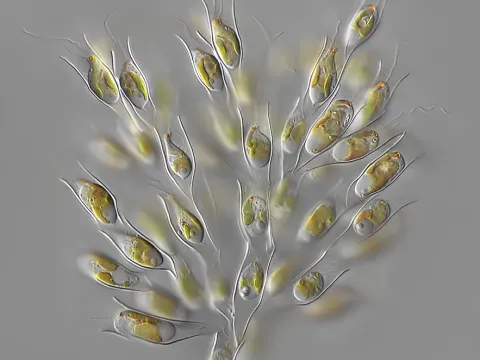
Dinobryon
Dinobryon sertularia
Dinobryon (scientific name Dinobryon sertularia) is a colonial golden alga that belongs to the phytoplankton community and is known to cause water blooms in freshwater ecosystems.
What the section contains
Dinobryon
The organism forms branched colonies of cells housed within delicate, vase-shaped loricae. It possesses both chloroplasts for photosynthesis and the ability to ingest organic matter, making it a mixotrophic organism.
In an agricultural and aquatic management context, Dinobryon serves as a biological indicator of water quality. Its presence in large quantities often reflects an imbalance in the aquatic environment.
Although it does not act as a traditional plant pathogen for terrestrial crops, its role in affecting water resources used for irrigation and aquaculture makes it a subject of agricultural interest.
The biological nature of this alga allows it to persist and thrive in diverse freshwater conditions, often dominating other planktonic species under specific environmental triggers.
The development of Dinobryon sertularia populations is primarily driven by nutrient availability, specifically high concentrations of phosphorus and nitrogen in the water column.
The species prefers cool to moderate water temperatures and is frequently observed to bloom during the spring and autumn seasons when conditions for growth are optimal.
Stagnant or slow-moving water bodies, such as farm ponds and irrigation reservoirs, provide the perfect habitat for these algae to form dense, macroscopic colonies.
Runoff containing agricultural fertilizers from nearby fields is a major contributor to the proliferation of these organisms, leading to sudden spikes in biomass.
Low levels of predation by zooplankton can further allow Dinobryon colonies to expand unchecked, leading to significant changes in water quality parameters.
The primary concern regarding Dinobryon is the degradation of water quality, as the decay of large colonies can produce unpleasant odors and tastes.
In aquaculture settings, the mass proliferation of these algae can negatively impact fish health and reduce the overall productivity of the aquatic system.
In irrigation systems, large amounts of algal biomass can physically clog filters and spray nozzles, increasing maintenance requirements and operational downtime.
The diurnal oxygen fluctuations caused by dense algal populations can induce hypoxia, posing risks to other aquatic life and the overall biological stability of the water body.
Water contaminated with excessive organic algal matter may have altered chemical properties, potentially affecting the efficiency of irrigation water usage for sensitive crops.
Effective management begins with reducing nutrient runoff from agricultural lands, which helps limit the primary food source for algal blooms.
Biological control methods, such as encouraging the population of planktivorous organisms like daphnia, can help keep algal levels under natural regulation.
Implementing effective mechanical filtration systems at the intake of irrigation systems can prevent biomass from entering and obstructing farm equipment.
Regular chemical analysis and monitoring of water sources help identify potential bloom risks before they reach critical levels, allowing for timely intervention.
- Strict management of fertilizer application on nearby lands.
- Deployment of appropriate filtration for irrigation water.
- Enhancement of natural zooplankton populations.
- Periodic monitoring of water quality parameters.