
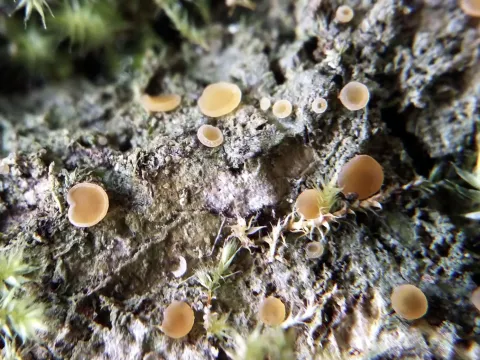
Dimerella lutea
Dimerella lutea
Dimerella lutea manifests as small, rounded, yellow to orange-yellow apothecia (fruiting bodies) scattered across the bark of trees. These structures are the most visible diagnostic feature of the species.
What the section contains
Dimerella lutea
The thallus, or the vegetative body of the lichen, is typically very thin and crustose, often blending in with the bark's texture. It may appear as a pale or greenish film surrounding the brighter fruiting bodies.
These lichens do not form thick or leathery layers, but rather appear as small spots or mosaics on the surface of the bark, particularly on broad-leaved trees.
Observation is easiest during or after rainfall, as moisture increases the color intensity of the apothecia, making them stand out against the darker background of the tree bark.
Since it is an epiphyte, the growth is superficial. It does not cause swellings, necrotic lesions, or any internal structural damage to the host plant's wood or vascular system.
Dimerella lutea is not a pathogen in the traditional sense, as it does not infect the host plant or extract nutrients from it. It is a crustose lichen belonging to the family Gyalectaceae.
The organism is a symbiotic association between a fungus and a chlorococcoid green alga. This partnership allows the lichen to survive on substrates where other organisms might struggle.
The fungus provides the framework and protection for the alga, while the alga produces carbohydrates through photosynthesis, sustaining both organisms.
Reproduction occurs via spores produced in the apothecia. These spores are dispersed by wind or water and colonize new surfaces when conditions are appropriate.
Because it requires specific environmental conditions to establish, Dimerella lutea serves as an ecological bioindicator of air quality and microclimatic humidity.
The primary factor for the development of Dimerella lutea is high atmospheric humidity. It thrives in sheltered, damp environments where moisture remains on the bark for extended periods.
Densely planted areas or orchards with poor airflow often harbor this lichen, as the lack of ventilation prevents the bark from drying out after rainfall.
The tree species also influences colonization. Bark with a specific texture and chemical composition can favor the attachment of spores, making some trees more susceptible than others.
Shaded sides of the trunk, typically the north-facing side, provide the stable, cool, and moist microclimate that this lichen prefers for optimal growth.
Seasonal patterns, such as humid autumns or rainy springs, facilitate the active spread of the lichen as it gains the necessary water to fuel its metabolic processes.
Dimerella lutea is generally considered harmless to trees. It is strictly an epiphyte, using the bark only as a physical platform without invading the living tissues of the host.
In very dense colonies, lichens may potentially trap small amounts of moisture and provide a micro-habitat for minor arthropods, though this rarely constitutes a significant pest problem.
For ornamental or commercial orchards, the presence of lichen might be viewed as a negative aesthetic factor, but it does not impede the tree's vital physiological functions.
There is no evidence that Dimerella lutea inhibits the photosynthesis of leaves or causes bark rot. Its impact is almost entirely visual rather than biological.
The only real concern arises if the presence of lichen masks the symptoms of other, more dangerous diseases, making it harder for a grower to conduct a timely diagnosis of the tree's health.
Since Dimerella lutea is not a parasitic disease, chemical fungicides are rarely recommended or necessary. Cultural practices are the most effective way to manage it.
Pruning is the best preventative measure. By thinning the canopy and removing low-hanging branches, you increase sunlight penetration and air circulation around the trunk.
Physical removal can be achieved through gentle scrubbing with a soft wire brush or scraper. This is helpful if you want to clean the bark for purely aesthetic reasons.
Applying a lime wash to the trunks is a traditional and effective method to clean the bark and create an environment that discourages the regrowth of lichens.
Ensuring overall tree vigor through proper fertilization and watering helps the tree maintain healthy bark, which is generally less prone to heavy lichen colonization than weak or aged bark.