
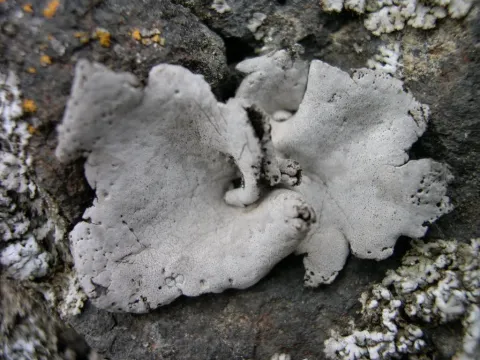
Dermatocarpon
Dermatocarpon
Dermatocarpon is a genus of crustose or foliose lichens that appear as scale-like structures on the surfaces of tree bark or rocks.
What the section contains
Dermatocarpon
The thallus typically manifests as small, flat plates or lobes ranging in color from olive and brown to gray, adhering closely to the substrate.
Small dark dots, known as perithecia, are often visible on the lichen surface, representing the fruiting bodies of the fungal component.
When colonizing woody plants, these lichens look like mottled patches that can eventually cover large areas of the trunk or branches.
It is important to distinguish the presence of Dermatocarpon from fungal necrotrophic diseases, as this lichen does not penetrate deeply into living plant tissues.
Biologically, Dermatocarpon is not a plant disease in the traditional agricultural sense but is classified as a genus of lichen in the Verrucariaceae family.
The organism is a symbiotic complex consisting of an ascomycete fungus and green algae that generate nutrients through photosynthesis.
The fungal partner provides the physical structure, protection from desiccation, and anchorage to the substrate through specialized hyphae.
The algal partner, often from the genus Trebouxia, resides within the thallus and converts solar energy into organic matter.
As such, Dermatocarpon does not have an infectious stage typical of pathogens and does not release toxins that damage host plant cells.
The development of Dermatocarpon is directly influenced by environmental humidity levels and air quality in a given area.
Shaded locations with high relative humidity provide the most favorable conditions where lichens can remain in an active state for extended periods.
This genus is commonly found on rocks near water bodies or in old orchards where trees possess rough, slowly expanding bark.
The presence of Dermatocarpon is often a biological indicator of clean air, as these organisms are highly sensitive to atmospheric pollutants.
The slow growth rate of these colonies limits their spread, making the colonization of new bark surfaces a process that spans many years.
The primary concern regarding Dermatocarpon involves its ability to create a micro-habitat for insect pests and potential fungal pathogens.
A thick layer of lichen on a trunk may trap moisture, which, under specific conditions, could encourage the premature softening of the bark surface.
While the organism itself is not parasitic, an excessive presence on tree crowns may indicate overall plant stress or poor canopy ventilation.
In young saplings, heavy coverage might theoretically interfere with normal gas exchange through lenticels, although this is rarely a limiting factor.
In most commercial orchard environments, Dermatocarpon is not considered a significant threat and does not require immediate eradication measures.
Preventative management of lichens focuses on proper horticultural practices, including regular sanitary pruning to improve canopy airflow.
Mechanical removal of loose, dead bark using scrapers can effectively clear lichen colonies without damaging the living tree tissues.
If population density is high, applying iron sulfate solutions during the dormant period is an effective method for destroying the thalli.
Whitewashing trunks with a lime-based solution serves as an important care measure, creating an environment unfavorable for lichen spore attachment.
- Thinning the canopy to allow increased sunlight penetration.
- Timely removal of old, dead, or heavily colonized branches.
- Supporting overall tree vigor through balanced mineral nutrition.