
Dermatocarpon miniatum
Dermatocarpon miniatum
Description
Pathogen
Dermatocarpon miniatum is a foliose lichen belonging to the Verrucariaceae family. It is strictly a lichenized fungus and is not a plant disease, despite occasional confusion in non-specialized literature.
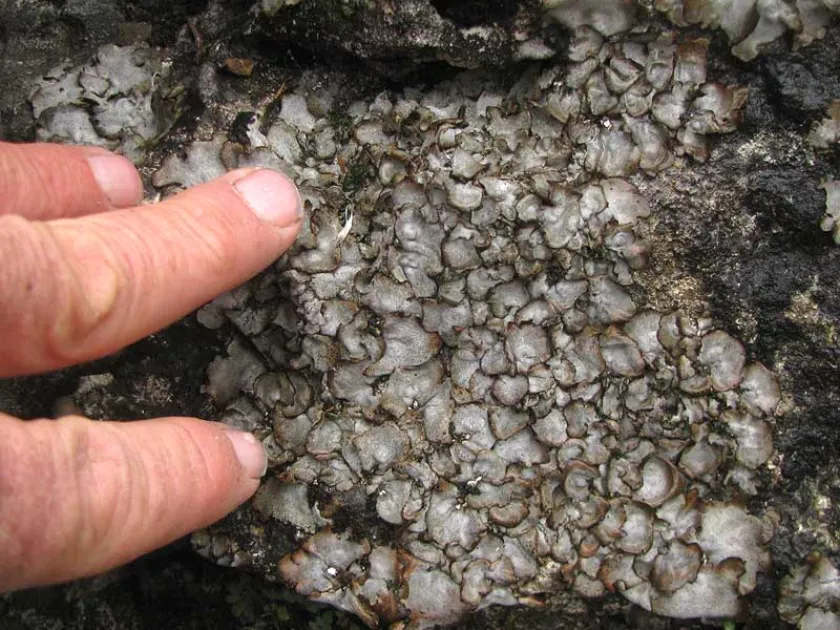
The thallus is leaf-like, attached by a central holdfast known as a gomphus. Its color ranges from ash-gray to dark reddish-brown depending on hydration and light exposure.
Like other lichens, it functions as a symbiotic system between a fungal partner and photosynthetic algae. It draws nutrients from the air and minerals from the substrate, not from plant tissues.
The reproductive structures, or perithecia, are embedded within the thallus and appear as tiny dark dots. They are essential for the dispersal of spores under appropriate environmental conditions.
Because it lacks the ability to infect or parasitize vascular plants, it is not classified as a pathogen in any agricultural or horticultural context.
Conditions for development
This species thrives in well-lit environments, often colonizing limestone, calcareous rocks, and occasionally concrete surfaces in natural or urban settings.
It displays remarkable resilience to moisture fluctuations. During periods of drought, the lichen becomes brittle and desiccated, resuming active metabolism upon rehydration.
Dermatocarpon miniatum is considered a bioindicator of air quality. It is sensitive to sulphur dioxide and nitrogen pollution, indicating cleaner environments when present.
Growth is extremely slow, typically occurring over years rather than months. It requires a stable substrate to establish its characteristic foliose colonies.
The distribution of this lichen is primarily dictated by the availability of suitable mineral surfaces and specific microclimatic conditions such as humidity and light intensity.
Why it matters
There is no evidence that Dermatocarpon miniatum poses any risk to crops, orchards, or horticultural plants. It does not cause wilting, necrosis, or systemic infections.
The organism does not produce mycotoxins or enzymes capable of degrading plant cell walls, which distinguishes it from actual fungal pathogens.
Any perceived harm is restricted to the aesthetic modification of non-living surfaces like stone walls, fountain bases, or farm structural foundations.
It does not compete for resources, as it occupies a geological rather than an agricultural niche, meaning it has zero impact on yield or crop health.
Categorizing this lichen as a disease is scientifically inaccurate and leads to unnecessary interventions that do not improve farm efficiency.
Protection
No agricultural control measures are necessary. Applying fungicides to eradicate this lichen is harmful to the local ecosystem and ineffective for crop protection.
If removal from structural surfaces is desired for cosmetic reasons, mechanical cleaning with a stiff-bristled brush or power washing is the recommended approach.
Maintaining clean and dry building surfaces naturally discourages lichen colonization, making chemical treatments redundant and environmentally unsafe.
Focusing on genuine phytopathogens and integrated pest management is far more important than attempting to manage non-pathogenic organisms like lichens.
Practitioners should view the presence of Dermatocarpon miniatum as a natural element of the landscape, often serving as a positive indicator of ecological health.
Discussion
No discussions yet — be the first.