
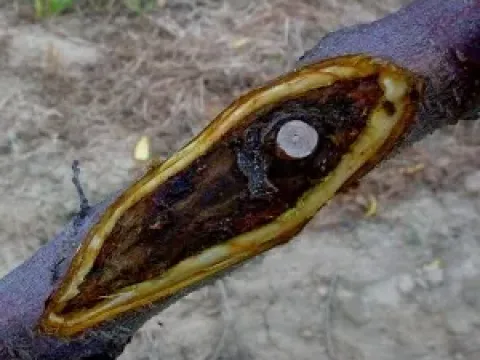
Pomegranate cytospora canker
Cytospora punicae
The causative agent of the disease is the fungus Cytospora punicae, a common pathogen affecting woody plants. It primarily colonizes the bark and cambium layers of pomegranate trees.
What the section contains
Pomegranate cytospora canker
The fungus functions as a parasite, disrupting the vascular system by destroying living tissues, which eventually leads to the wilting of branches above the infection point.
Cytospora punicae produces pycnidia, small, pimple-like fruiting bodies on the bark surface. These structures release conidia, which serve as the primary source of infection.
The spores are disseminated primarily by rainwater splashes, wind currents, and mechanical contact via gardening tools, facilitating the spread throughout the orchard.
The pathogen survives within infected wood and dead bark tissues, remaining dormant in the environment until suitable conditions for germination arise.
Initial symptoms include the yellowing and wilting of leaves on individual branches, which gradually dry up and die off as the infection progresses inward.
Sunken, discolored patches (cankers) appear on the bark surface. These lesions may range from brown to reddish-brown and often indicate localized tissue death.
Tiny, dark-colored pustules emerge through the epidermis of the bark. These are the pycnidia, which become visible as the disease advances on the dying bark.
The bark often develops cracks and begins to peel away from the wood. Beneath the bark, the wood turns dark brown to black, showing signs of severe fungal decay.
If the canker completely circles a branch, the entire portion of the plant beyond the site of infection will wither and die due to the loss of water and nutrient transport.
Environmental stress is a primary driver of the disease. Pomegranate trees suffering from drought, poor nutrition, or improper planting locations are significantly more susceptible.
High humidity and frequent rainfall provide ideal conditions for spore germination and infection, particularly during the active spring growing season.
Physical trauma is a major factor. Frost cracks, sunburned bark, and poorly executed pruning cuts serve as entry points for the fungus to colonize the tree.
Poor orchard sanitation, such as failing to remove dead wood or leaving prunings on the ground, creates a reservoir for the pathogen to spread to healthy trees.
Improper canopy management, leading to dense foliage and low airflow, traps moisture around the trunk and branches, fostering an environment where Cytospora punicae thrives.
Cytospora canker is a destructive disease that significantly reduces the lifespan and productivity of pomegranate trees if not managed promptly.
The damage to the vascular system limits the flow of water and nutrients, which directly impacts fruit set, causing stunted development or total fruit loss.
The disease causes branch dieback, which ruins the structural integrity of the tree and requires extensive pruning, potentially leading to the loss of the entire plant.
Infected trees become more vulnerable to secondary pests and cold stress, accelerating the degradation of the orchard and increasing long-term maintenance costs.
Financial impact is significant due to the loss of yield, the cost of fungicides, and the labor required for systematic sanitation and replacement of dead specimens.
Pruning is the most effective management strategy. All infected branches must be removed, cutting well back into healthy wood to ensure no diseased tissue remains.
All pruning wounds should be immediately sealed with a protective wound dressing or fungicide paste to prevent secondary fungal colonization.
Maintaining tree vigor is essential. Proper irrigation, balanced fertilization, and avoiding mechanical damage to the trunk help the tree resist potential infections.
Preventative spraying with copper-based fungicides during the dormant season and early spring is recommended to protect the bark from spore colonization.
- Sterilize pruning tools with alcohol between each tree
- Remove and destroy all infected plant debris by burning
- Apply white latex paint or lime to trunks to prevent sunscald
- Use biostimulants to improve the natural immune response of the tree