
Poplar and larch leaf rust
Melampsora laricis-tremulae
Description
Symptoms
On larch needles, the disease presents as small, yellowish-orange pustules that eventually rupture to release a powdery mass of spores.
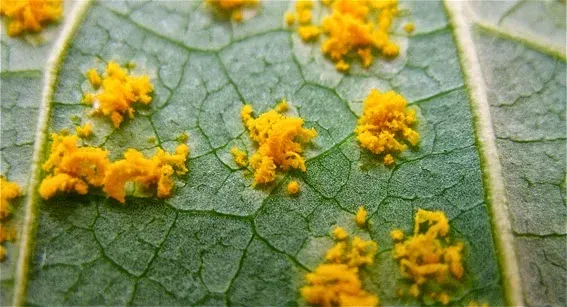
On poplar leaves, the symptoms appear as vibrant orange-yellow spots on the underside of the leaf, indicating high activity of the fungus.
Affected tissues typically yellow and dry out prematurely, leading to widespread leaf drop which compromises the aesthetic value of the trees.
The leaves may exhibit significant curling and chlorosis, severely impacting the tree's overall photosynthetic capacity during the growing season.
- Orange pustules on larch needles in spring.
- Bright yellow clusters on the abaxial side of poplar leaves.
- Premature yellowing and leaf shedding.
- Branch dieback during severe, multi-year infestations.
Pathogen
The causative agent of this disease is the heteroecious rust fungus Melampsora laricis-tremulae. This pathogen requires two distinct plant hosts to complete its complex biological life cycle.
The fungus begins its cycle by infecting larch trees, where it produces aecia. Subsequently, the infection spreads to poplars or aspens, where it undergoes massive asexual reproduction through urediniospores.
The fungus overwinters in the form of teliospores on fallen poplar leaves. In the spring, basidiospores generated from these overwintered spores infect young larch needles, initiating the cycle anew.
The fungus exhibits high environmental plasticity, allowing it to colonize host tissues rapidly when moisture levels are sufficient for spore germination.
Due to its specialized nature, the fungus effectively utilizes the temporal overlap in the development of its host plants, which exacerbates the spread of the disease.
Conditions for development
Persistent cool and damp weather during the spring months provides optimal conditions for the infection of larch needles by fungal spores.
Summer spread is favored by fluctuating temperatures combined with high humidity, which promotes rapid sporulation on poplar leaves.
Poorly ventilated stands with dense canopy cover trap moisture, facilitating the internal spread of the pathogen throughout the population.
The presence of uncollected leaf litter acts as a primary reservoir for the overwintering inoculum, ensuring the disease returns annually.
Insufficient spacing between poplar and larch plantations significantly increases the probability of cross-infection, leading to severe outbreaks.
Why it matters
The primary damage results from premature defoliation, which limits the tree's ability to accumulate reserves for winter dormancy and spring growth.
Chronically infected trees exhibit reduced wood growth and overall vigor, making them susceptible to secondary infestations by bark beetles or wood-boring insects.
In nursery settings, the disease causes significant economic loss as saplings may become deformed or stunted, rendering them unsuitable for sale.
In urban landscapes, the aesthetic degradation caused by leaf rust necessitates costly maintenance, including sanitation and chemical treatments.
Long-term infestation can lead to tree mortality in sensitive populations, ultimately reducing the resilience of the local ecosystem to other stressors.
Protection
Sanitation is the most critical control measure; removing and composting or burning fallen leaves significantly reduces the inoculum pressure.
Maintaining adequate spatial separation between poplar and larch trees is essential to break the pathogen's required host rotation.
If chemical intervention is necessary, applying systemic fungicides during the early stages of spore development can effectively curb the spread of the infection.
Proper silvicultural practices, such as thinning dense stands, improve airflow and help create an environment less favorable for fungal proliferation.
Selecting and planting resistant cultivars is a sustainable strategy to mitigate the impact of rust in both forest plantations and ornamental landscapes.
Discussion
No discussions yet — be the first.