
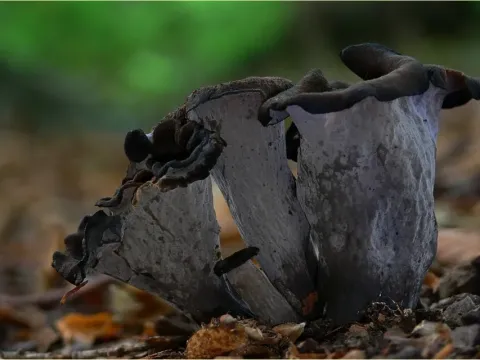
Horn of Plenty
Craterellus cornucopioides
The Horn of Plenty (Craterellus cornucopioides) is a wild edible mushroom and does not function as a plant disease or a parasite.
What the section contains
Horn of Plenty
As a saprotrophic fungus, it obtains nutrients from decaying organic matter rather than feeding on living host plants.
It lacks the physiological mechanisms necessary to infect or damage plant tissues, meaning it poses no risk to agricultural crops.
In mycological terms, it is a decomposer that plays a positive role in soil health by facilitating the breakdown of leaf litter.
Therefore, it is entirely incorrect to classify this organism as a plant pathogen within the scope of agronomy or plant pathology.
This fungus thrives in cool, moist environments typically found in deciduous forests with dense canopy coverage.
It requires a consistent layer of leaf litter and humus-rich soil to sustain its underground mycelial network.
High relative humidity and frequent rainfall are essential triggers for the development of its fruiting bodies.
It is rarely found in open agricultural fields or managed gardens, as it demands a specific forest microclimate.
Stable soil conditions with moderate temperatures are preferred for its slow but steady colonization of forest ground.
The fungus is completely harmless to living vegetation, including crops, ornamental plants, and forest trees.
Its presence does not lead to necrosis, chlorosis, root rot, or any other pathological symptoms on plants.
It does not compete for space or nutrients with agricultural crops, as it strictly occupies niches in wild forest environments.
There is no economic harm associated with this species; in fact, it is highly valued as a gourmet culinary product.
No agricultural control measures, such as fungicides or sanitation, are required, as it is a natural component of the forest floor.