
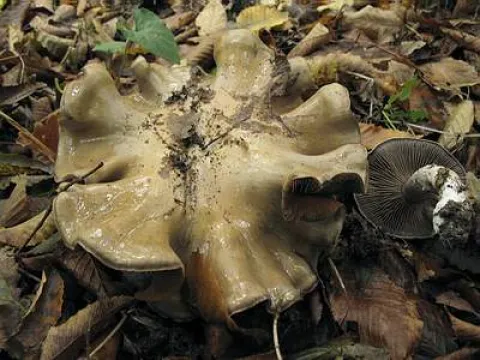
Broken webcap
Cortinarius infractus
The Broken webcap (Cortinarius infractus) is a mushroom species belonging to the family Cortinariaceae. It is a common woodland fungus that forms symbiotic ectomycorrhizal relationships with trees.
What the section contains
Broken webcap
The organism is not a plant pathogen; therefore, it does not cause diseases in crops, vegetables, or ornamental plants. It is exclusively an inhabitant of forest ecosystems.
The biological development of the fungus relies on mycelium that spreads through the forest litter and topsoil, decomposing organic matter and interacting with tree roots.
The species is named for the presence of a cobweb-like veil (cortina) covering the gills of immature mushrooms, which serves as a protective mechanism for the spore-producing surface.
From an agricultural standpoint, Cortinarius infractus is classified as a non-harmful saprotrophic or mycorrhizal species that does not require intervention.
The cap of the mushroom ranges from 4 to 10 cm in diameter, typically displaying olive-brown or yellowish-brown tones with a greyish overlay. It is often viscid or slimy under wet conditions.
The gills are initially olive-green but darken to a rusty-brown hue as the spores reach maturity. This coloration is characteristic of most Cortinarius species.
The flesh is dense and pale yellow or white, often showing an olive tint near the stem base. It is famously bitter, which acts as a deterrent to most potential consumers.
The stem is solid and cylindrical, often with a swollen or bulbous base. Vestiges of the cobweb-like cortina may remain on the upper part of the stem.
Spore prints are rusty-brown, which confirms the identification of the specimen within the broader Cortinariaceae family.
The Broken webcap thrives in deciduous and mixed forests where moisture levels are high. It prefers the damp, shaded environments typical of mature woodlands.
Optimal growth occurs during late summer and autumn, provided there is consistent rainfall to keep the soil and leaf litter saturated.
The fungus is often associated with tree species such as oak, beech, and birch, relying on their root systems to establish mycorrhizal connections.
Soil acidity plays a role, with the fungus showing a preference for slightly acidic to neutral forest soils rich in decomposing organic debris.
Temperature fluctuations within a mild range (12°C to 18°C) are considered ideal for the induction of fruiting body formation in this species.
There is no economic or agronomic harm associated with the Broken webcap, as it does not infect plants or reduce the viability of agricultural crops.
The fungus possesses no parasitic traits and does not negatively impact the health or productivity of any garden or field plant varieties.
The primary concern regarding this species is its non-edibility for humans due to its intensely bitter taste, which remains even after prolonged cooking.
It does not function as a vector for plant diseases, nor does it compete with crops for nutrients in any economically significant way.
Its role is limited to the forest biome, where it contributes to nutrient cycling and maintains the structural integrity of the soil food web.
No chemical or biological control measures are needed for the Broken webcap, as it is a harmless component of the natural ecosystem.
Preventative strategies in agriculture do not include this species, as it is not a target organism for pest or disease management programs.
Good soil management practices and maintaining field hygiene are sufficient to prevent any encroachment of forest fungi into active agricultural areas.
In cases of land clearing for new farming plots, standard soil preparation involving the removal of deep forest litter and root debris is naturally effective.
Agricultural personnel should not confuse this species with soil-borne pathogens and should focus management efforts on known agricultural pests instead.