
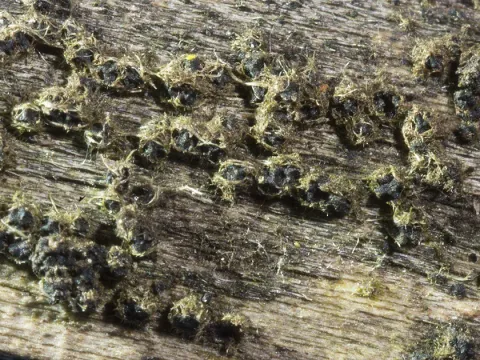
Coronophora gregaria
Coronophora gregaria
The causative agent is the ascomycete fungus Coronophora gregaria. It acts primarily as a saprotroph or weak parasite, thriving on the bark and woody tissues of weakened deciduous trees.
What the section contains
Coronophora gregaria
The fungus develops its stroma beneath the plant's periderm. As the stroma matures, it ruptures the bark, revealing characteristic dark, clustered fruiting bodies that indicate the presence of the pathogen.
As a member of the Coronophoraceae family, this fungus shows a high degree of host specificity, preferring stressed woody substrates where the protective layer of the bark has been compromised.
The fungal growth causes tissue destruction within the bark, interfering with nutrient transport and water circulation, which gradually weakens the affected branches or the entire tree.
Microscopic inspection reveals specialized structures typical of this species, allowing plant pathologists to distinguish it from other wood-decaying fungi.
The primary symptom of the disease is the appearance of small, black, densely packed fungal fruiting bodies on the surface of branches and stems.
In the affected areas, the bark becomes brittle, changes color to a dull gray or brownish shade, and eventually begins to peel off from the underlying wood.
Trees suffering from this infection often exhibit generalized symptoms such as stunted leaf growth, premature leaf yellowing, and visible dieback of terminal shoots.
If the infection progresses, the necrotic areas may girdle the branches, leading to a complete cessation of vital processes in those parts of the canopy.
Close inspection often shows the rupture of the outer periderm, through which the fungal stromata emerge in distinctive crown-like formations.
The disease spreads most aggressively on trees that are already compromised by environmental stressors, such as severe drought, cold injury, or soil compaction.
High humidity and consistent rainfall provide the ideal conditions for spore germination and the further colonization of the plant's surface tissues.
Dense, overcrowded plantations with poor airflow create a stagnant microclimate that promotes the rapid development and dispersal of Coronophora gregaria.
Physical injuries to the tree bark, caused by maintenance machinery or insect infestation, serve as primary entry points for the fungal spores.
Lack of proper sanitation, such as failing to remove and destroy dead or infested wood, allows the fungus to survive and accumulate within the habitat.
Coronophora gregaria significantly reduces the aesthetic and structural value of ornamental trees and forest stands.
The primary danger lies in the development of bark necrosis, which can lead to the systemic weakening of the tree and, eventually, premature death.
Affected trees are highly susceptible to secondary infestations by wood-boring insects, further compounding the damage caused by the fungus.
In nursery settings, the infection can cause significant losses by rendering the young planting material unsuitable for distribution.
Large-scale infections in urban or forested areas necessitate intensive management efforts, including the removal of infected trees to protect the surrounding environment.
The most effective management strategy involves prompt pruning of infected branches, followed by the immediate destruction of the material by burning.
Maintaining vigorous tree health through adequate irrigation and nutrient management is essential for enhancing the plant's natural resistance to the pathogen.
Preventive application of fungicides during the early spring period helps minimize the fungal spore load on the bark surface.
Protecting tree trunks from physical damage, frost cracks, and sunscald is crucial for preventing the infection from establishing itself in the first place.
Ongoing monitoring and early detection allow for localized interventions, which are significantly more effective than attempting to treat advanced, widespread infections.