
Apiosporina
Apiosporina
The disease is caused by the fungus Apiosporina (commonly known as Apiosporina morbosa), a member of the Ascomycota phylum.
What the section contains
Apiosporina
This pathogen is an obligate parasite that colonizes the cambial layers of susceptible branches, leading to abnormal cell proliferation.
The life cycle involves the production of ascospores during the spring, which are dispersed by rain and wind to infect new, succulent growth.
The mycelium resides within the host tissue, causing the development of dense, hardened stromatic masses over the course of the growing season.
The pathogen is capable of surviving harsh winter conditions within the woody tissues of the host, ensuring its persistence in the orchard environment.
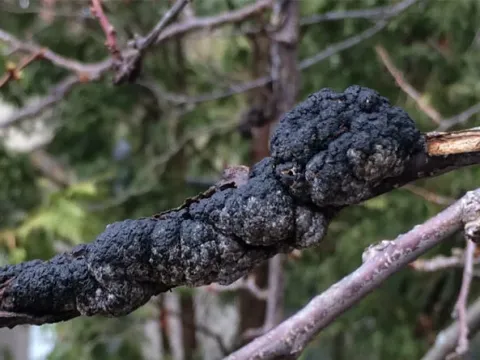
The hallmark symptom is the formation of elongated, rough, and swollen growths known as "black knots" on stems and branches.
In the spring, these growths appear as soft, olive-green swellings, which are covered in millions of microscopic conidia spores.
As the season progresses, the knots turn black, become very hard, and develop a characteristic cracked, woody surface texture.
Heavy infections can cause the affected branches to become distorted, bent, or entirely girdled, leading to leaf drop and branch death.
Early-stage infection may be difficult to detect, but as the fungus matures, the dark, irregular masses become highly visible against the bark.
The development of Apiosporina is heavily favored by prolonged periods of wet, rainy weather during the spring months.
Moderate temperatures ranging from 15 to 25 degrees Celsius facilitate the rapid germination and colonization of new host tissues.
Poor orchard sanitation, such as failing to remove infected wood, provides a constant reservoir of spores for subsequent years.
Dense canopies that lack sufficient airflow maintain humidity levels around the branches, creating optimal conditions for infection.
Wounds caused by pruning, insects, or winter injury provide easier entry points for the fungal spores to establish infection.
This disease can severely reduce the vigor of fruit trees, leading to stunted growth and significantly decreased annual yields.
If left uncontrolled, the infection spreads rapidly throughout the crown, eventually resulting in the death of major scaffold branches.
The presence of large knots impedes the transport of nutrients and water, starving the parts of the tree located distal to the infection.
Trees infected with Apiosporina become increasingly susceptible to secondary stressors, including frost damage and pest infestations.
In high-density commercial orchards, a severe outbreak can necessitate the removal of large portions of the crop, causing major economic impact.
The most effective management strategy is the rigorous pruning and removal of all infected branches during the dormant season.
Cuts should be made at least 10-15 centimeters below the visible knot to ensure the removal of all internally infected wood.
All pruned material must be removed from the orchard and burned or buried to prevent the release of spores during the spring.
Applying copper-based fungicides during the dormant period can help protect tree tissues against initial spring spore infections.
- Sanitize pruning tools with alcohol or bleach between each cut;
- Monitor the orchard regularly, especially in early spring;
- Maintain tree health through proper fertilization and watering practices.