
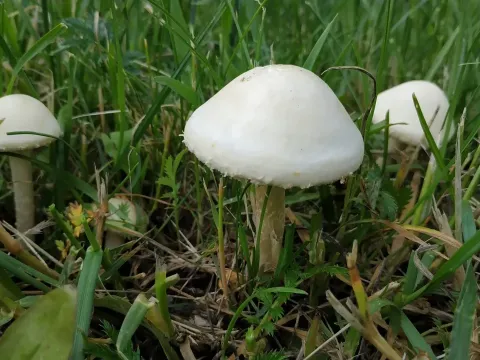
Hard agrocybe
Agrocybe dura
The hard agrocybe (Agrocybe dura) is a saprotrophic fungus that manifests primarily as fruit bodies on the soil surface or organic debris. Visually, these mushrooms feature dense, cream-colored or ochre caps that often crack during dry conditions.
What the section contains
Hard agrocybe
In an agronomic context, the presence of this fungus's mycelium indicates active decomposition of organic substrates within the root zone. The cap's surface is typically dry and matte, serving as a key diagnostic feature for field identification.
Clusters of these mushrooms are frequently observed around the stems of grain crops or in grassy field areas. Early stages of growth may be mistaken for root rot, but the development of fruit bodies allows for precise identification.
Mycelium development in the soil alters substrate structure, potentially restricting water accessibility for plant roots. During mass appearance, localized suppression of crop growth in the vicinity of the fungus is often noted.
A key identifying characteristic is the ring on the mushroom stem, which often degrades over time. As the mushroom matures, the gills change from whitish to dark brown due to spore production, which is visible on adjacent vegetation.
The pathogen is a basidiomycetous fungus belonging to the Strophariaceae family. It is a typical saprotrophic organism that can occasionally exhibit weak parasitic traits on weakened plant hosts.
The disease type in agronomy is classified as a mycorrhizal or saprotrophic infection of the root zone, which can hinder the normal development of crops under specific conditions.
The fungus actively decomposes cellulose and lignin, making it common in fields with high levels of crop residue. Its biological cycle involves the growth of a robust mycelial network within the topsoil.
Reproduction occurs via spores carried by the wind over significant distances. Upon reaching moist soil, spores germinate to form primary mycelium, which subsequently colonizes available organic substrates.
The fungus demonstrates high adaptability to various soil types, preferring well-fertilized or grass-covered areas. Its ability to survive harsh conditions ensures a persistent infection reservoir over multiple seasons.
The development of Agrocybe dura is closely linked to high soil moisture and moderate ambient temperatures. Peak fruiting occurs during periods following heavy rainfall in late spring and early summer.
Abundant non-decomposed organic matter (straw, stubble, manure) serves as an ideal nutritional source for the fungus. Poor soil aeration also facilitates the spread of mycelium throughout the field.
Optimal temperatures for mycelial growth range from 15 to 22 degrees Celsius. Extreme heat or soil freezing temporarily halts development but does not eliminate the mycelium.
Violation of crop rotation schedules and leaving crop residues in the field create a favorable environment for the mass propagation of this species. Plants suffering from nutrient deficiencies are more vulnerable to the fungus's impact.
Prolonged foggy weather and high air humidity promote intense sporulation, leading to rapid colonization of new areas. The fungus adapts easily to competition with native soil microflora.
The harmfulness of the hard agrocybe lies in its competition with crops for soil nutrients and moisture. During mass development, the mycelium can obstruct water access to the root system.
While not a specialized pathogen, the fungal activity alters the soil's chemical composition, indirectly suppressing grain crop growth and reducing overall field productivity.
Infected areas often exhibit uneven germination and slower growth rates compared to healthy zones, complicating agricultural planning and harvesting operations.
The presence of numerous fruit bodies hinders mechanical soil cultivation and can serve as an indicator of poor agricultural practice. In some cases, the fungus may facilitate the development of root rots by weakening plant defenses.
In long-term grass-covered fields, the fungus may influence the composition of vegetation, displacing beneficial species. Reduced grain quality due to impaired nutrition is an additional negative factor.
The primary control method is high-quality and timely soil tillage. Deep plowing facilitates the burial of crop residues, depriving the fungus of its nutritional source and disrupting mycelial growth.
Adherence to proper crop rotation is mandatory for prevention. Avoiding excessive field grass cover and alternating crops with different root systems helps reduce fungal colony density.
Removal of fungal fruit bodies before full maturation is recommended to prevent further spore dissemination, especially in small fields or protected crop environments.
The application of mineral fertilizers in optimal doses strengthens the immune system of crops, making them less susceptible to the negative impact of saprotrophic fungi.
Chemical protection is rarely used specifically for this fungus, but broad-spectrum fungicides applied during general crop health treatments can suppress mycelial development.