
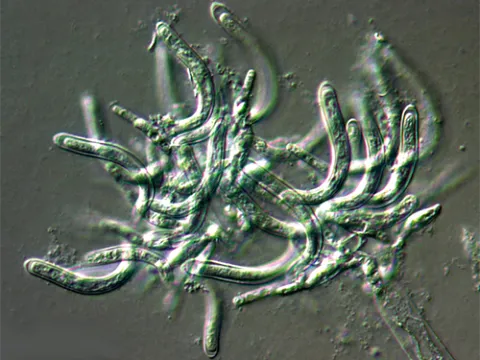
Harpellales
Harpellales
Harpellales is an order of fungi belonging to the subphylum Kickxellomycotina. It is important to state clearly that Harpellales are not plant pathogens or diseases.
What the section contains
Harpellales
These organisms are obligate symbionts that reside exclusively in the digestive tracts of various aquatic insect larvae, such as mayflies and stoneflies.
They possess no biological mechanism to infect or harm agricultural crops, horticultural plants, or forestry trees.
Their life cycle is strictly tied to the aquatic environment and the physiological processes of their insect hosts.
Labeling Harpellales as a "plant disease" is a scientific error and holds no relevance in agricultural practice.
As Harpellales are not plant pathogens, there are absolutely no signs or symptoms of disease on any cultivated plants.
Visual diagnostic methods used for crop diseases will never identify Harpellales on leaves, stems, or roots.
The fungi can only be observed under laboratory conditions within the gut lining of their specific insect hosts.
Since they do not impact plants, there is no need to monitor for their presence in fields or greenhouses.
Any damage to crops must be attributed to other, recognized plant pathogenic fungi, bacteria, or viruses.
The development of Harpellales is strictly limited to aquatic ecosystems where their insect hosts thrive.
Factors such as water quality, flow rate, and the population density of aquatic insects determine the prevalence of these fungi.
External agricultural factors, such as soil fertilization or crop rotation, have zero impact on the biology of these fungi.
They remain confined to the water bodies and do not interact with terrestrial farming conditions.
Understanding their environmental conditions is solely a matter of ecological and entomological research.
Harpellales cause no harm to the agricultural industry because they do not attack or degrade plant tissue.
There is zero economic impact associated with these organisms, as they are completely irrelevant to plant health.
They are not considered pests, and they do not affect yield quality or quantity.
Scientific evidence confirms that their role is purely restricted to symbiotic relationships within insect populations.
Therefore, farmers and agronomists do not need to account for Harpellales in their crop protection strategies.
There are no control or prevention measures for Harpellales, as they do not constitute a threat to plant health.
The application of fungicides against these fungi is completely unnecessary and would be a waste of resources.
Agronomic effort should be focused entirely on managing actual threats to plant health such as fungal pathogens or pests.
No agricultural guidelines exist for controlling Harpellales because they are not part of the agricultural ecosystem.
In case of unexplained plant symptoms, professional phytopathological analysis should always be performed to identify the actual culprit.