
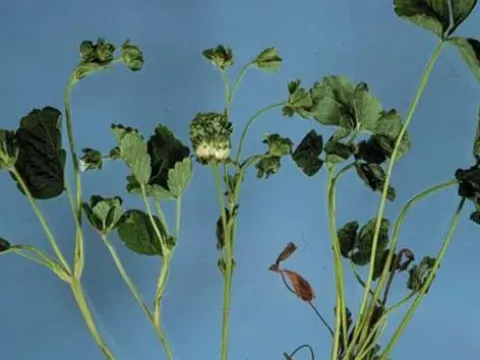
Strawberry green petal
Strawberry multiplier
Strawberry green petal is a serious phytoplasma disease affecting strawberry crops worldwide. Phytoplasmas are specialized prokaryotes lacking a cell wall that reside specifically in the sieve tubes of the plant's phloem.
What the section contains
Strawberry green petal
The pathogen belongs to the "yellows" group of diseases and systemically affects the plant's conductive system. Unlike viruses, phytoplasmas can replicate both within the host plant and inside their insect vectors.
Wild host plants, particularly perennial weeds surrounding strawberry fields, act as primary reservoirs for the pathogen, allowing it to persist throughout the season even in the absence of crop plants.
Transmission occurs through vegetative propagation using infected runner plants and biologically via insect vectors, primarily leafhoppers. Once an insect feeds on an infected plant, it carries the phytoplasma and transmits it to healthy strawberry plants.
Since the disease is systemic, the pathogen spreads throughout the entire plant, affecting roots, crowns, and floral structures, leading to the chronic degradation of the strawberry plant's health.
The most distinctive symptom is the phyllody of floral parts, where petals turn green and assume leaf-like characteristics, which gives the disease its common name.
As the infection progresses, flower stalks become shortened, thick, and stunted. Flowers are often malformed, with reproductive organs like stamens and pistils transforming into sterile leaf-like appendages.
Leaves on infected plants are significantly smaller and may exhibit inward curling. The entire plant often takes on a "witch's broom" appearance due to excessive, stunted branch growth and abnormal bud proliferation.
Foliage may show chlorosis or reddening, indicating a severe disruption of the photosynthetic process caused by the blockage of the phloem tissue by the phytoplasma.
- Green, leaf-like petals instead of normal white ones.
- Deformed, sterile flowers that produce no fruit.
- Reduced leaf size and distorted foliage.
- Stunted plant growth and overall weak appearance.
- Complete loss of commercial berry yield.
The prevalence of the disease is strongly linked to the population dynamics of insect vectors. Hot and dry summers often trigger spikes in leafhopper activity, facilitating faster spread across the field.
High-density plantings with poor airflow create a conducive microclimate for vectors, allowing them to move easily between plants and spread the infection more rapidly.
The proximity of abandoned fields or unmaintained field margins containing host weeds significantly increases the risk of initial infection, as these areas support stable vector populations.
Cultural practices, such as failing to remove infected runners or weeds during the season, contribute to the rapid buildup of the pathogen within the crop area.
Peak transmission periods usually coincide with the active growth phase of the strawberry, when insect vectors are migrating and feeding most aggressively.
The primary economic impact is the total loss of fruit production, as infected plants become sterile and either fail to set fruit or produce small, malformed, and unmarketable berries.
Infected plants suffer from systematic decline and typically die within one or two growing seasons, as the pathogen impairs nutrient transport and depletes the plant's energy reserves.
Green petal is devastating for commercial nurseries, as infected mother plants serve as a source of disease for future propagation, leading to widespread loss of stock.
Because early-stage symptoms can be subtle and easily overlooked, the disease is frequently spread inadvertently through the sale and planting of infected runners.
Once established, an infected field may require complete eradication and a fallow period, as the pathogen can persist in the soil environment and root debris.
The most effective strategy is the use of certified, virus-free, and phytoplasma-free nursery stock, produced via tissue culture techniques to ensure initial plant health.
Implement a rigorous integrated pest management program to control leafhoppers and other potential vectors through the timely application of systemic insecticides.
Regular field scouting is essential; any plant displaying symptoms of green petal should be immediately rogued out and destroyed by burning to limit the spread of the pathogen.
Maintain proper field sanitation by controlling weeds in and around the plantation, as these serve as the secondary host plants for the phytoplasma and the vectors.
Rotate crops and maintain spatial separation from wild reservoirs to break the infection cycle and prevent the reintroduction of the disease to new strawberry plantings.