
Clover anthracnose
Italian clover
Clover anthracnose is a fungal disease caused by Colletotrichum trifolii. This pathogen is a significant threat to various legume species, causing extensive damage to forage quality.
What the section contains
Clover anthracnose
The fungus overwinters in soil debris and can persist on seeds, making it a difficult pathogen to eradicate once it establishes in a field.
It propagates through conidia, which are easily spread by splashing water during rain events or by agricultural machinery moving through the field.
The fungus penetrates plant tissues, primarily through the stems and petioles, where it develops mycelium that disrupts nutrient transport.
The pathogen is highly aggressive, and specialized races of C. trifolii have evolved to overcome standard resistant traits in some clover varieties.
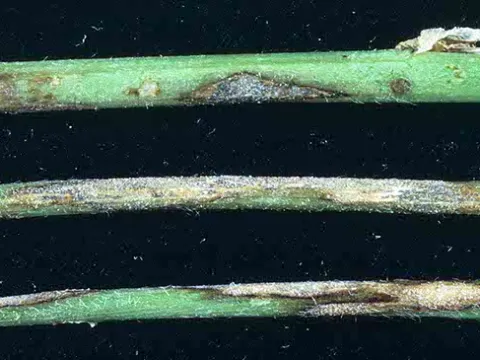
The most distinctive signs of clover anthracnose are dark, sunken, elongated lesions on the stems and petioles of the host plant.
These lesions often start as small, light-colored spots that darken significantly as the fungus begins its spore production.
Plants often exhibit a characteristic 'shepherd's crook' appearance at the tip of the stem, caused by the collapse of infected tissue.
In humid conditions, small, dark, raised fungal structures (acervuli) may become visible on the surface of the lesions.
Severe infections lead to the wilting and eventual death of entire shoots, causing patches of brown, withered foliage in the field.
Warm and moist weather conditions are essential for the development and spread of Colletotrichum trifolii infections.
Temperature ranges between 22°C and 28°C, combined with prolonged leaf wetness, create optimal environments for fungal spore germination.
High plant density and lush canopy growth promote humidity within the stand, allowing the fungus to spread rapidly between plants.
Frequent summer rains are the primary driver of disease outbreaks, as water droplets facilitate the movement of spores.
Poor soil drainage can also indirectly contribute to increased disease severity by stressing the plants and keeping the canopy environment moist.
The primary impact of clover anthracnose is a substantial reduction in both biomass yield and overall forage quality.
Infected plants contain fewer leaves and lower protein levels, which directly diminishes their value as livestock feed.
The disease contributes to stand thinning, as infected plants are more susceptible to winter kill and other environmental stresses.
Economic losses arise from the need to reseed fields earlier than expected due to premature stand decline caused by fungal infections.
In severe cases, the entire harvest can be lost if the infection causes significant lodging and plant death before the optimal cutting time.
The most effective strategy is to plant resistant clover varieties that have been bred specifically to tolerate C. trifolii.
Implementing a proper crop rotation schedule helps reduce the level of primary inoculum present in the field soil.
Good agricultural practices, such as ensuring proper soil drainage and avoiding over-fertilization with nitrogen, can help manage disease risks.
Sanitation is critical; cleaning machinery between fields and removing infected plant debris helps prevent the spread of the fungus.
While fungicide applications exist, they are often cost-prohibitive for large-scale forage production and are mostly used for seed production crops.