
Wheat gumming disease
Rathayibacter iranicus
The causal agent of wheat gumming disease is the bacterium Rathayibacter iranicus. It is a Gram-positive aerobic pathogen belonging to the Microbacteriaceae family.
What the section contains
Wheat gumming disease
This microorganism colonizes the vascular system of host plants, leading to the occlusion of xylem vessels which disrupts the transport of water and nutrients.
The bacterium is closely associated with nematodes of the genus Anguina, which act as vectors and primary wounding agents, facilitating bacterial entry into the plant tissues.
Transmission occurs primarily through infested seeds, where the bacteria can persist for extended periods in a state of anabiosis.
The pathogen is well-adapted to arid environments, making it particularly dangerous for regions where winter wheat is grown under moisture-stressed conditions.
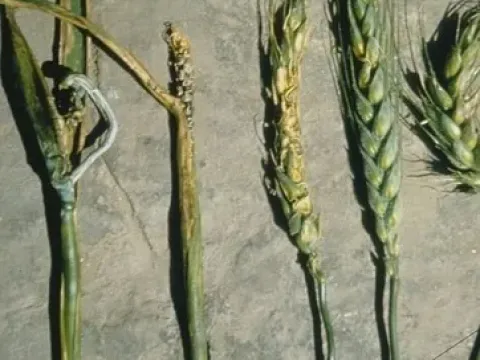
Key symptoms include the deformation of stems and leaves, which often appear twisted, curled, or stunted in growth.
Characteristic bacterial galls form on the heads (spikes), containing a thick, sticky, gum-like exudate that gives the disease its common name.
Plants affected by Rathayibacter iranicus show signs of severe chlorosis, overall stunting, and reduced vigor throughout the growing season.
In cases of heavy infestation, the heads fail to develop properly, leading to grain sterility or the production of shriveled, discolored seeds.
Visual inspection may reveal dark streaking or necrosis on the stems, resulting from the accumulation of bacterial masses within the vascular bundles.
The disease development is tightly linked to the life cycle of the nematode vectors, which become active under specific moisture and temperature regimes in the spring.
Favorable conditions for infection involve sufficient soil moisture during seed germination and the early vegetative stages, allowing bacteria to migrate via the vector.
High population densities of Anguina nematodes in the soil significantly increase the risk of disease outbreaks in winter wheat fields.
Reduced tillage practices or monocropping systems contribute to the build-up of the pathogen and its nematode hosts in the field soil.
Fluctuating temperatures between seasons influence the survival rate of bacterial cells within crop residues left on the field after harvest.
The primary economic impact is a drastic reduction in grain yield, which can lead to near-total crop failure in extreme epidemic scenarios.
Infested grain is unfit for seed purposes, as it acts as a carrier for the pathogen and perpetuates the disease cycle in subsequent seasons.
The infection negatively impacts grain quality and weight, making the harvest unsuitable for commercial milling and food processing standards.
Field emergence is severely hampered when using infected seed lots, leading to uneven stands and poor plant establishment.
Economic losses include direct yield reduction, the cost of replacing contaminated seed stocks, and the implementation of costly soil sanitation measures.
The most effective management strategy is the use of high-quality, certified, pathogen-free seed sources to prevent introduction.
Implementation of crop rotation is essential to break the nematode vector's life cycle and reduce the inoculum pressure in the field.
Deep plowing and proper management of crop debris help eliminate overwintering sites for both the bacterium and its associated nematodes.
Weed control is critical, especially regarding grasses that can act as alternate hosts or reservoirs for the pathogen.
In high-risk areas, the deployment of resistant wheat varieties and seed treatments designed to suppress nematode-bacterial complexes is recommended.