
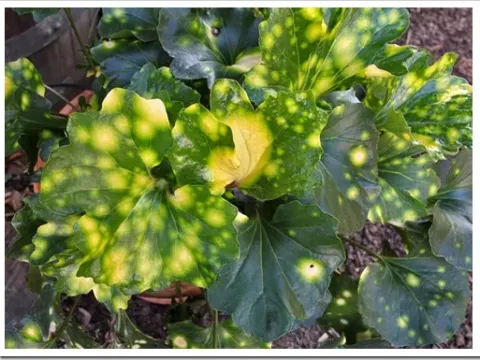
Witches broom of Farfugium
Tsuwabuki witches
The causative agent of this disease is phytoplasma, a specialized group of wall-less bacteria that inhabit the phloem tissue of the host plant.
What the section contains
Witches broom of Farfugium
These pathogens are obligate parasites, meaning they rely entirely on the host's vascular system for their metabolic activities and survival.
Phytoplasmas are primarily transmitted by phloem-feeding insects, such as leafhoppers, which acquire the bacteria while feeding on infected sap.
Because these microorganisms cannot be cultured in laboratories using standard methods, identifying the infection usually involves DNA-based testing (PCR).
Once inside the plant, the pathogen manipulates hormonal signals, leading to the erratic and uncontrolled growth patterns observed in affected specimens.
The characteristic sign is the development of dense clusters of thin, stunted shoots emerging from a single point, resembling a broom.
Affected leaves are significantly smaller than normal, often displaying chlorosis or a yellowish tint that indicates a disruption in nutrient transport.
Internodes are severely shortened, resulting in a bushy, deformed appearance that prevents the plant from reaching its natural size and shape.
Flowering is usually suppressed or completely inhibited; if flower stalks do form, they are typically distorted, frail, and often fail to open properly.
As the disease progresses, the plant exhibits signs of general decline, including root rot susceptibility and a failure to thrive despite adequate fertilization.
Development is heavily dependent on the presence and activity level of insect vectors, which typically thrive in warm and humid conditions.
Crowded plantings and poor airflow favor the movement of insect vectors from infected plants to healthy ones, facilitating rapid disease spread.
High temperatures can accelerate the multiplication of phytoplasmas within the plant vascular tissues, leading to faster symptom onset.
The proximity of weed reservoirs, which may host the pathogen without showing obvious symptoms, significantly increases the risk of infection in garden beds.
Excessive nitrogen application can encourage succulent, tender growth that is highly attractive to sap-sucking pests, increasing the likelihood of pathogen transmission.
Witches broom is a systemic and incurable condition that causes long-term structural and physiological damage to the Farfugium plant.
The aesthetic value of the plant is completely compromised, making it unsuitable for landscape use and requiring immediate removal from garden designs.
Infected plants serve as a persistent source of inoculum for other garden species, potentially leading to a widespread decline in plant diversity.
The overall vigor and hardiness of the plant are significantly reduced, making it more vulnerable to secondary environmental stresses like drought or cold.
Economically, this disease causes total loss of individual specimens, and the mitigation efforts require significant investment in pest management.
The primary and most effective management practice is the immediate physical removal and destruction of symptomatic plants, including the entire root system.
Insecticide programs should be implemented to control population levels of leafhoppers and other potential vectors during the growing season.
Preventive strategies include sourcing healthy, pathogen-free planting stock from reputable nurseries to avoid introducing the disease into the garden.
Maintaining a weed-free environment around Farfugium plantings helps reduce the population of alternative hosts that could carry the phytoplasma.
Regular monitoring and early detection of symptoms are critical, as removing a single plant early can prevent a major infestation in the garden landscape.