
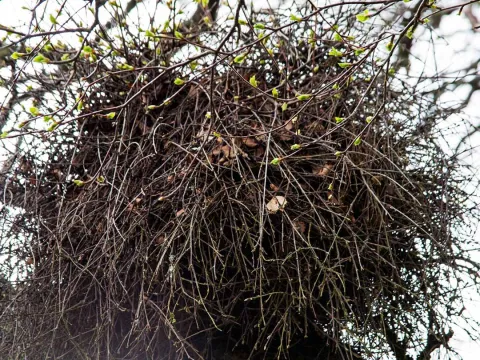
Walnut witches broom
Walnut witches
The most distinctive symptom of this disease is the proliferation of thin, weak shoots that grow in dense, brush-like clusters. These structures resemble a broom, which gives the disease its common name.
What the section contains
Walnut witches broom
Affected leaves are typically smaller than normal, often exhibiting chlorosis or irregular curling. The shoots themselves have very short internodes, making the cluster appear compact and unnatural.
During the dormant season, these "witches' brooms" are clearly visible against the bare branches due to their density and unique, tangled appearance. Growth in these areas is unproductive and eventually dies back.
The disease tends to progress systematically, slowly spreading from one branch to the entire canopy. Infected trees show a marked decline in health, losing their typical structural integrity over time.
Fruit production ceases or becomes significantly distorted on infected limbs. As the disease advances, the entire tree eventually fails to produce any viable nuts or healthy vegetative growth.
The disease is caused by a phytoplasma (Walnut witches' broom phytoplasma), which is a specialized type of bacteria that lacks a cell wall. It resides exclusively within the plant's phloem tissue.
Phytoplasmas are obligate parasites, meaning they cannot survive or multiply outside of their host plant or insect vector. They interfere with the plant's hormonal signaling, triggering the abnormal shoot growth.
Transmission occurs primarily through phloem-feeding insects, such as leafhoppers, which ingest the pathogen while feeding on an infected tree and transmit it to a healthy one later.
The pathogen is systemic, moving through the tree's transport system. Once established, it is extremely difficult to eradicate because it colonizes the vascular pathways throughout the entire plant.
Detection of the phytoplasma cannot be done via simple observation; it requires molecular diagnostic techniques, such as PCR, to identify the specific genetic material of the pathogen in plant tissue samples.
The prevalence of the disease is closely tied to the population density of its insect vectors. Warm, humid environments generally favor the migration and activity of these insects, increasing infection rates.
Alternative hosts in the vicinity, including wild shrubs or weeds, act as reservoirs for the pathogen, allowing it to persist in the environment even when no orchard trees are nearby.
Propagation via infected scion wood is a major risk factor in commercial nurseries. If a bud or graft is taken from an infected tree, the disease is transferred directly into the new plant.
Stressed trees are more vulnerable to the development of symptomatic growth. Drought, nutrient deficiencies, or soil issues can exacerbate the speed at which the disease manifests throughout the canopy.
Mild winters may allow insect vectors to survive in higher numbers, leading to an increased risk of disease transmission early in the following growing season.
The primary economic impact is the total loss of nut yield on infected trees. Since the tree diverts its energy into producing useless "broom" growth, fruit production is completely inhibited.
Walnut Witches' Broom is a chronic condition that typically leads to the tree's death. There is no known cure for infected trees, making the disease a long-term threat to the entire orchard.
The disease serves as a constant source of inoculum. If not managed, it can spread to healthy trees, potentially leading to the destruction of an entire plantation over several years.
Infected trees become weakened and are more susceptible to opportunistic secondary pathogens, such as fungal cankers or wood-rotting organisms, which further degrade the tree's health.
The loss of canopy integrity and overall tree vigor reduces the aesthetic and commercial value of the orchard, often necessitating the removal of the entire affected block.
The most important control measure is the early detection and removal of infected branches. Pruning cuts should be made well below the visible symptoms, and the debris must be burned immediately.
Sanitizing tools between cuts is essential. Using alcohol or a strong disinfectant solution prevents the mechanical transmission of the pathogen during maintenance work.
Management of the insect vector population is critical. Targeted insecticide applications during peak activity periods for leafhoppers can reduce the rate of new infections in the orchard.
Only certified, disease-free nursery stock should be used for planting. It is vital to ensure that the mother trees used for grafting have been tested and verified as clean.
In cases of severe infestation, the only effective management strategy is the removal and destruction of the entire tree, including the root system, followed by a fallow period before replanting.