
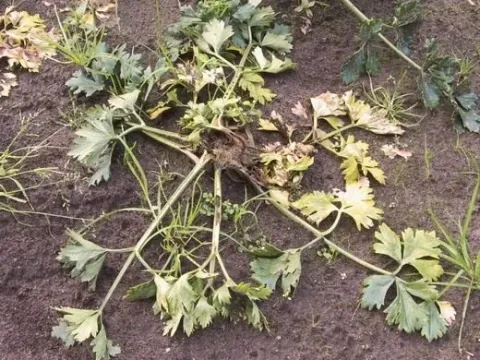
Enterobacteriosis
Enterobacter
The pathogens of enterobacteriosis are a group of facultative anaerobic bacteria belonging to the Enterobacteriaceae family. In agricultural practice, the most common genera are Erwinia, Pectobacterium, and Enterobacter.
What the section contains
Enterobacteriosis
These microorganisms are Gram-negative bacilli that actively develop within plant tissues, utilizing them as a nutrient medium. The disease is typically classified as bacterial rot or tissue necrosis.
These bacteria possess an enzymatic apparatus capable of degrading pectin substances in plant cell walls. This leads to the softening of tissues and loss of structural integrity, which is the key mechanism of pathogenesis.
The infection can be transmitted through soil, contaminated plant debris, and via insect vectors. Seeds can also harbor latent forms of the infection, which complicates early diagnosis.
A critical characteristic is the high rate of pathogen reproduction under favorable conditions. Bacteria can quickly colonize the vascular system or parenchyma of the host plant, causing systemic infection.
The primary external symptom is the appearance of wet, rapidly expanding lesions on leaves, stems, or fruits. The affected areas often exhibit an oily texture and a distinct, foul odor.
On root crops and succulent fruits, soft rot often develops, turning internal tissues into a shapeless, mushy mass. This is accompanied by tissue darkening and deformation of plant organs.
When the vascular system is affected, the plant exhibits wilting, even if soil moisture is adequate. Stem cross-sections may show darkening of the conducting bundles.
Under high humidity, bacterial exudate often appears on the surface of affected tissues as droplets or a slimy film. This is the primary method of infection spread under field conditions.
- Yellowing and necrosis of the leaf blade.
- Softening of fruit and tuber tissues.
- Characteristic sharp, rotting odor.
- Wilting of shoot tips.
- Slimy discharge on affected plant parts.
High humidity and soil moisture levels are the primary drivers of enterobacteriosis development. Excessive irrigation or prolonged rainfall create an ideal environment for bacterial activity.
The optimal temperature range for most pathogens is between +20 and +30 degrees Celsius. During this period, bacterial metabolism is at its peak, significantly accelerating disease progression.
Micro-wounds on plant surfaces greatly facilitate the penetration of the infection. Damage caused by pests, hail, or agricultural operations acts as an entry point for the pathogen.
Dense planting and poor aeration create a microclimate with high humidity within the crop canopy. This significantly increases the risk of rapid bacteriosis spread.
Deficient potassium nutrition or excess nitrogen fertilization weakens plant immunity, making them more susceptible to bacterial pathogens of the Enterobacteriaceae family.
Enterobacteriosis causes significant economic losses by leading to mass plant death in early development stages. Seedlings may die even before emerging from the soil.
The disease is highly dangerous during storage, as infected fruits or roots rapidly contaminate healthy produce. This leads to substantial losses in warehouses and storage facilities.
A decrease in product quality makes the harvest unsuitable for sale and long-distance transport. Affected produce loses its flavor profile and biological value.
The long-term persistence of bacteria in the soil makes it impossible to grow susceptible crops on the same field for several years, disrupting effective crop rotation.
Control measures require significant financial investment in bactericides. Moreover, the effectiveness of chemical protection is often limited by the systemic nature of the infection.
The foundation of control is strict adherence to crop rotation, returning susceptible crops to the same field no earlier than after 3–4 years. It is essential to select resistant varieties and hybrids.
High-quality seed disinfection before planting can eliminate surface-borne infections. Using seed treatments with antibacterial properties significantly lowers the risk of epiphytotics.
Regular monitoring and control of insect pest populations are crucial, as they not only damage tissues but also act as active vectors for bacterial spread in agroecosystems.
Timely removal and destruction of crop residues are necessary, as they serve as the main reservoir for the infection during the winter season. Deep plowing facilitates better residue decomposition.
During storage, strict temperature and humidity regimes must be maintained. Proper ventilation in storage facilities prevents the spread of rot from initial infection sites to healthy produce.