
Description
Symptoms
The primary symptom is the appearance of white or creamy shiny spots on the undersides of leaves. These look like crust-like formations that eventually become denser and more prominent.
Yellowish chlorotic spots emerge on the upper side of the leaf, corresponding to the infected areas below. Over time, these tissues become necrotic and wither.
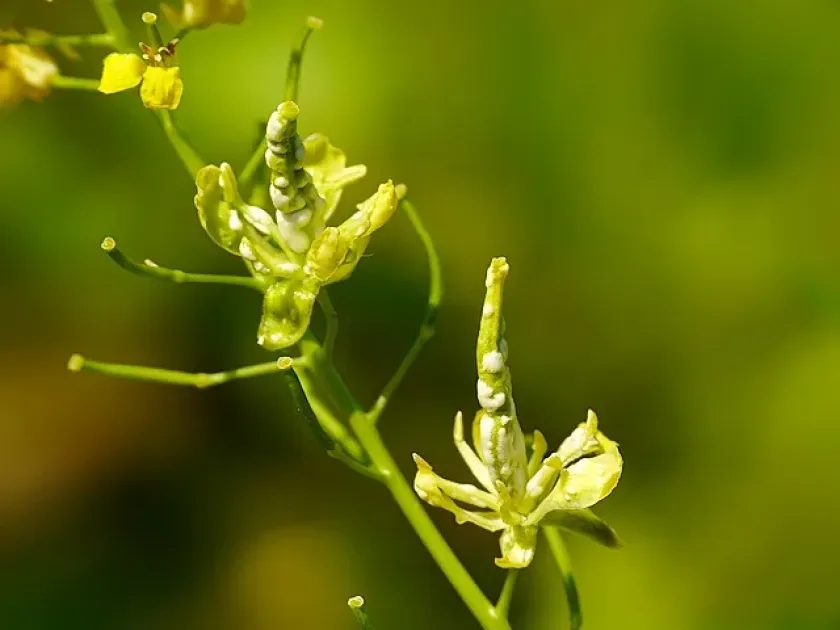
A distinctive sign is the significant deformation of plant organs. In rapeseed and turnip, one often observes twisted stems, thickened flower stalks, and floral sterility.
Under high humidity, pustules may merge to cover large areas of the leaf. This leads to premature wilting and falling of the leaves, weakening the plant.
- White pustules (spore masses).
- Chlorosis of leaf tissues.
- Deformation of stems and inflorescences.
- Premature leaf death.
Pathogen
The causative agent of the disease is the oomycete Albugo candida, which belongs to the group of downy mildew-like pathogens. It is a highly specialized parasite affecting plants of the Brassicaceae family.
The life cycle involves the formation of zoosporangia, which are easily dispersed by wind, rain splashes, or irrigation. The infection persists in the soil and on crop residues as oospores, which can remain viable for several years.
The parasite enters the plant tissue through stomata and develops in the intercellular spaces. As the sporangia mature, they rupture the epidermis, creating characteristic white, shiny pustules.
The fungus affects a wide range of crops, including winter rapeseed, turnip, cabbage, radish, and various mustard species. It is also frequently found on wild cruciferous weeds, which serve as an infection reservoir.
The biological nature of the pathogen allows it to adapt quickly to environmental changes. Its high reproductive capacity contributes to the rapid spread of the disease under favorable conditions.
Conditions for development
The disease develops best at moderate temperatures ranging from +15 to +22 degrees Celsius. These conditions are ideal for the germination of zoosporangia and tissue colonization.
The presence of free moisture on the plant surface is the key factor for infection. Frequent rainfall, heavy dew, or overhead irrigation significantly accelerate the disease process.
Dense crops with poor air circulation create a microclimate that retains high humidity, favoring the spread of the pathogen. This is especially true for thick rapeseed stands.
The physiological state of the crop also plays a role in susceptibility. Plants stressed by nutrient deficiencies or adverse environmental conditions are more prone to infection.
The disease is most prevalent in wet growing seasons. While dry weather may suppress the development of the pathogen, the presence of oospores in the soil ensures its survival for future seasons.
Why it matters
The harm caused by white rust is primarily due to the reduction of the leaf area available for photosynthesis, leading to stunted plant growth and development.
Infection of reproductive organs leads to significant yield losses. Deformation of inflorescences can prevent seed set or lead to the development of malformed seeds, which is critical for seed-producing crops.
The market quality of the produce is compromised. For root crops like turnip, the aesthetic value is reduced, and storage life is shortened due to an increased risk of secondary rot.
The disease can lead to total crop failure during severe outbreaks. For winter rapeseed, infection in the autumn can reduce winter hardiness and plant survival.
Economic damage includes the cost of additional fungicide applications and the potential loss of harvest volume. Sorting and grading infected produce also increases operational costs.
Protection
Crop rotation is the most effective management strategy. Brassicaceae crops should not be planted on the same field more than once every 3 to 4 years to break the infection cycle in the soil.
Rigorous weed control is essential, as many cruciferous weeds act as alternative hosts for Albugo candida. Keeping fields and headlands clean reduces the inoculum load.
Proper management of crop residues is important. Deep plowing helps bury infected plant material, promoting its decomposition and reducing the number of surviving oospores.
Farmers should select resistant or tolerant varieties and hybrids. Using certified, healthy, and seed-treated material prevents the introduction of the pathogen into new areas.
Chemical protection involves the use of fungicides during critical growth stages. Copper-based products or systemic fungicides are most effective when applied at the first signs of pustule formation.
Pathogens and affected parts
Affects crops · 2
Discussion
No discussions yet — be the first.