
Disease · fungal · affects Common hop, Common oat, Common sunflower
Stunt nematode
Tylenchorhynchus claytoni
Description
Symptoms
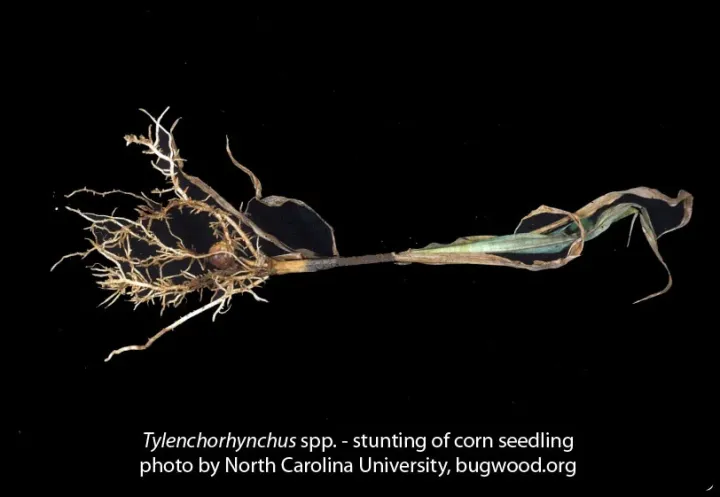
Above-ground symptoms typically manifest as patches of stunted or uneven growth within a field, often appearing in irregular patterns.
Affected plants often show signs of nutrient deficiency, such as chlorosis, due to the compromised root system's inability to absorb necessary minerals.
In hot or dry conditions, infested plants are prone to premature wilting because they lack the root mass to maintain proper water uptake.
Root system examination often reveals necrosis, discoloration, and a significant reduction in fine root hairs compared to healthy plants.
In some cases, the root system may appear brown or decayed, which further reduces the plant's ability to anchor itself and survive environmental stress.
Pathogen
The stunt nematode, Tylenchorhynchus claytoni, is a microscopic plant-parasitic nematode that lives in the soil and feeds on the roots of plants.
As an ectoparasite, it does not typically burrow inside the root tissue but rather uses its stylet to pierce root cells and extract nutrients from the outside.
This feeding behavior causes significant damage to the root system, which subsequently inhibits the overall growth and development of the host plant.
The nematode has a wide host range, making it a persistent threat in diverse agricultural and horticultural environments.
Common host plants include oats, watermelon, sunflower, Jerusalem artichoke, hops, lettuce, sweetgum trees, and tobacco.
Conditions for development
Tylenchorhynchus claytoni thrives in warm, moist soil environments which facilitate their mobility and reproductive cycles.
Light-textured soils, such as sandy or loamy soils, provide optimal conditions for the migration of nematodes towards host plant roots.
Excessive rainfall or irrigation can assist in the spread of these pests across fields via water runoff, expanding the infested area.
Monocropping or continuous planting of susceptible hosts creates a favorable environment for population buildup over multiple seasons.
Presence of weeds during the fallow period provides a continuous food source, allowing the nematode population to persist in the field year-round.
Why it matters
The primary economic impact is a reduction in total yield and the quality of the harvested produce, affecting profitability.
The root damage renders plants less competitive and more susceptible to secondary soil-borne diseases, which can lead to complete stand loss.
Reduced vigor makes plants highly susceptible to drought stress and environmental fluctuations, leading to inconsistent crop stands.
For perennial crops, repeated annual feeding by the stunt nematode can lead to long-term decline and eventual death of the plant.
In tobacco and sunflower production, the stunt nematode can cause significant financial losses due to lower biomass and decreased nutrient content.
Protection
Crop rotation with non-host species is the most effective cultural practice to manage stunt nematode populations in the soil.
Strict sanitation protocols for farm equipment are essential to prevent the spread of contaminated soil from one field to another.
Using cover crops known to have suppressive effects on nematode populations can help reduce the density of Tylenchorhynchus claytoni.
Applying nematicides or seed treatments can provide early-season protection, although these must be used according to local environmental regulations.
Soil testing before planting is highly recommended to assess nematode pressure and determine if preventative treatments are necessary for the chosen crop.
In brief
13
Affects crops
Biology
Pathogens and affected parts
Pathogens
Tylenchorhynchus claytoni· nematode
Tylenchorhynchus· nematode
Unknown· fungus
Tylenchorhynchus clarus· nematode
Quinisulcius capitatus· fungus
Merlinius· fungus
Prune dwarf· fungus
Prunus necrotic· fungus
Prunus necrotic· fungus
Quinisulcius acutus· fungus
Tylenchorhynchus nudus· nematode
Tylenchorynchus· fungus
Affected plant parts
whole plant
Content graph
Affects crops · 13
Content graph
Connections · Stunt nematode
Most often together:
Marketplace
Products · 2

Community
Discussion
No discussions yet — be the first.