
Description
Symptoms
Symptoms of Typhula blight become most apparent immediately following snowmelt in early spring when the vegetation begins to emerge from dormancy.
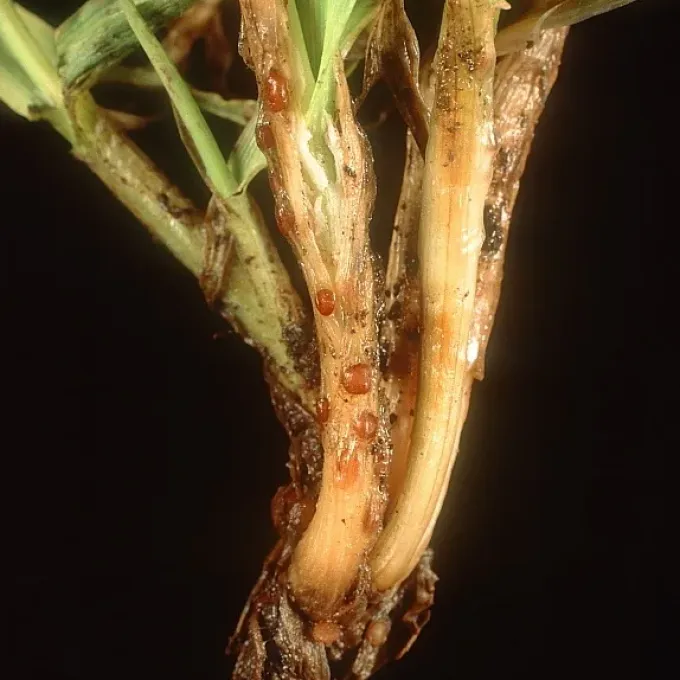
A distinctive white or grayish fungal mat appears on the leaves and crowns of infected plants, indicating active colonization by the pathogen.
Small, spherical sclerotia can often be observed on the affected leaf tissue, transitioning in color from light brown to a dark, almost black appearance as they mature.
Infected leaves and stems gradually turn brown and die, leading to the collapse of affected tillers and potentially the death of the entire plant crown.
Fields affected by the disease often show thin, patchy stands with uneven growth, significantly deviating from the healthy appearance of neighboring plots.
Pathogen
The causal agent of Typhula blight is the fungus Typhula idahoensis, a basidiomycete that persists in the soil and on crop residues through specialized survival structures called sclerotia.
These sclerotia are highly resilient to extreme winter conditions, allowing the pathogen to remain viable in the soil for extended periods even in the absence of a host.
The disease primarily targets winter cereals, with winter wheat and winter barley being the most economically significant hosts susceptible to infection during the cold season.
The fungus functions by colonizing plant tissues at the crown level, utilizing moisture trapped under snow cover to spread its mycelium across the field.
The biological cycle is strictly synchronized with winter temperatures, where the fungus thrives under the protective blanket of snow that moderates soil temperature.
Conditions for development
Prolonged snow cover on non-frozen soil provides the perfect environment for Typhula idahoensis, allowing it to grow even at near-freezing temperatures.
High humidity in the microclimate near the soil surface is essential for the rapid spread of the fungus from one infected plant to the next.
Excessive autumn growth, often caused by early sowing or high nitrogen rates, increases the risk of infection by providing more susceptible biomass for the fungus.
The duration of the winter season and the stability of the snow pack are the primary climatic determinants that influence the severity of the disease outbreak.
Fields located in low-lying areas with poor drainage are particularly susceptible to severe blight outbreaks due to increased moisture retention throughout the winter.
Why it matters
Typhula blight can cause significant stand reduction, requiring producers to undertake expensive reseeding operations in the spring to salvage the crop.
Damage to the crown and root system limits the plant's ability to recover in the spring, leading to stunted development and reduced tillering capacity.
The disease renders plants weaker and more prone to secondary infections, ultimately reducing the final grain yield and overall crop quality at harvest.
Economic losses are compounded by the costs of additional fungicides and labor required to mitigate the damage caused by the pathogen during the early spring.
Severe infestations can lead to substantial financial losses, particularly in regions where winter conditions consistently support the pathogen's development.
Protection
Implementing a robust crop rotation strategy, where cereals are not grown in successive years, is essential to break the pathogen's life cycle in the field.
Deep plowing and proper residue management help accelerate the decomposition of plant debris, thereby reducing the reservoir of sclerotia in the soil.
Seed treatment with systemic fungicides in the autumn is a critical line of defense, protecting seedlings during the critical stages of emergence and establishment.
Balanced fertilization, particularly adequate potassium levels, strengthens plant tissues and improves the overall winter hardiness of the crop.
- Selection of winter-hardy and resistant cereal varieties.
- Avoidance of excessively early sowing dates.
- Effective weed control to reduce humidity in the crop canopy.
- Targeted fungicide application if thresholds for disease are exceeded in spring.
Pathogens and affected parts
Affects crops · 2
Discussion
No discussions yet — be the first.