

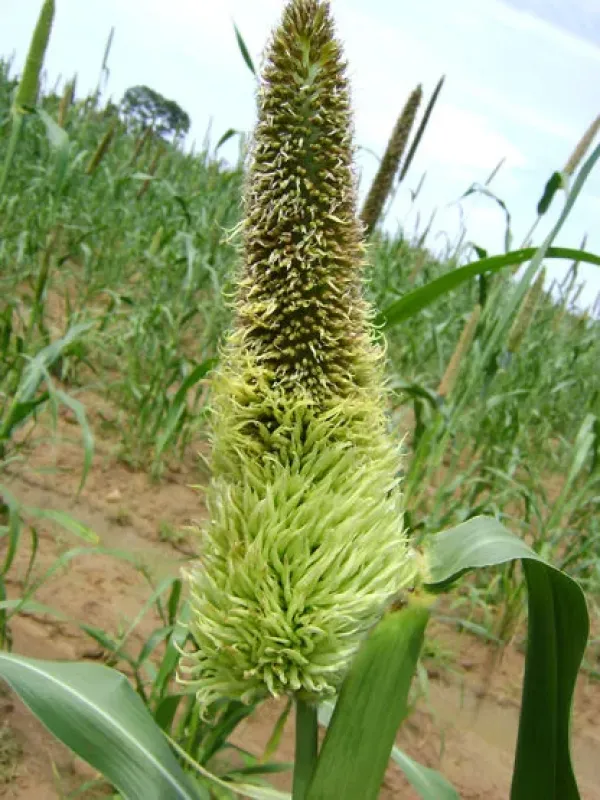
Description
Symptoms
The initial signs of infection often appear on young seedlings as yellow or chlorotic stripes running parallel to the leaf veins. As the disease progresses, these stripes may become white or brown, and the plant often exhibits severe stunting and stunted growth.
Under conditions of high humidity, a characteristic grayish, downy fungal growth appears on the undersides of the infected leaves. This layer consists of masses of sporangiophores and sporangia, facilitating rapid spread to neighboring plants.
In hosts like corn (maize), the disease causes extreme malformations of reproductive structures. Ears may fail to develop entirely, or they may be transformed into stunted, leafy, or tassel-like structures, a symptom frequently referred to as proliferation or "crazy top".
Root systems of infected plants are typically underdeveloped, leading to poor nutrient uptake and lodging. Additionally, affected plants often display excessive tillering, as the hormonal balance of the plant is completely disrupted by the systemic mycelial growth.
- Chlorotic striping on leaves.
- Gray downy growth on the underside of leaves.
- Stunting and severe plant deformation.
- Tassel-like malformation of ears.
- Excessive tillering and late development.
Pathogen
Sclerospora is a genus of plant pathogens belonging to the order Peronosporales, which are responsible for various systemic diseases known as downy mildew. The most economically significant species is Sclerospora graminicola, an obligate parasite that thrives on cereal crops.
The life cycle involves the production of zoosporangia, which are disseminated by wind or splashing rain. In the soil, the pathogen persists through thick-walled oospores, which can remain viable for several years, providing a persistent source of inoculum for subsequent seasons.
Once infection occurs, the mycelium colonizes the vascular tissues and intercellular spaces of the host. By using specialized structures called haustoria, the fungus absorbs nutrients directly from the plant cells, leading to severe physiological disruption and systemic weakness.
The biological activity of Sclerospora is heavily dependent on moisture. Zoospore motility requires a film of water on leaf surfaces or in the soil, meaning that irrigation practices and rainfall patterns directly dictate the severity of an outbreak.
Genetic diversity within the genus allows for the evolution of new races that can bypass existing resistance traits in crop varieties. This obligate nature means the pathogen requires living plant tissue to complete its cycle, yet the hardy oospores allow it to survive periods without a host.
Conditions for development
Sclerospora develops most rapidly under cool to moderate temperatures, typically between 15°C and 22°C. High relative humidity (above 80%) is the most critical environmental factor for the successful infection and transmission of the disease.
Periods of frequent rainfall or heavy dew provide the necessary surface moisture for zoospore germination and movement. Areas with poor soil drainage or high water retention are high-risk zones for the development of systemic infections.
Soil compaction can exacerbate the problem by keeping the root zone saturated for longer periods, facilitating oospore germination. Excessive nitrogen fertilization without adequate potassium and phosphorus can also render crops more susceptible to invasion.
The timing of planting is crucial; early-planted seeds in cold, wet soil are at a higher risk because they remain in the germination and seedling phase longer. During this slow growth period, the pathogen has a larger window of opportunity to infect the vulnerable tissues.
Presence of alternative host weeds within the grass family (Poaceae) allows the pathogen to survive in the environment during the off-season. Integrated management must account for these environmental drivers to effectively predict and mitigate potential epidemics.
Why it matters
The impact of Sclerospora is devastating, as systemic infection often renders the plant incapable of producing grain. In cases of early infection, entire seedlings may perish, leading to significant gaps in the field and reduced stand uniformity.
Infected plants suffer from impaired photosynthesis and water regulation, making them highly susceptible to secondary pathogens and abiotic stresses. These plants serve as local reservoirs of inoculum, putting the remainder of the field at high risk of rapid infection.
Economic losses are driven by both reduced yield quantity and poor grain quality. Furthermore, the persistence of oospores in the soil can restrict future land use, necessitating long-term rotations that may not be optimal for the farm's financial structure.
Massive outbreaks can destroy entire harvests, leading to substantial financial distress for growers. The systemic nature of the disease means that once a plant is infected, there is no curative treatment, making prevention the only viable strategy.
For agricultural producers, Sclerospora represents a significant phytosanitary challenge. Ignoring the threat leads to a cumulative increase in soil-borne inoculum, resulting in degraded soil health and consistently lower yields over multiple cycles.
Protection
The primary control measure is an effective crop rotation strategy, where host crops are excluded from the field for at least 3 to 4 years. This allows time for the soil-borne oospore population to naturally decline through attrition.
The use of fungicide-treated seeds is essential, particularly those containing systemic compounds like metalaxyl or mefenoxam. These chemicals provide critical protection during the vulnerable seedling emergence phase, preventing the initial systemic infection.
Cultural practices should focus on improving field drainage to eliminate standing water and saturated soil conditions. Deep plowing can help bury infected crop debris, accelerating decomposition and reducing the survival potential of the oospores.
Weed control is vital to remove potential alternative hosts that harbor the pathogen in and around the field. Maintaining a balanced fertility program ensures plants are vigorous, which can help them better tolerate lower levels of inoculum pressure.
Selecting and deploying resistant or tolerant hybrids is the most sustainable long-term solution. Regular monitoring of fields during early growth stages allows for early detection and localized containment of potential disease hotspots.
Content graph
Connections · Sclerospora
Most often together:
Marketplace
Products · 4


Community
Discussion
No discussions yet — be the first.