
Description
Symptoms
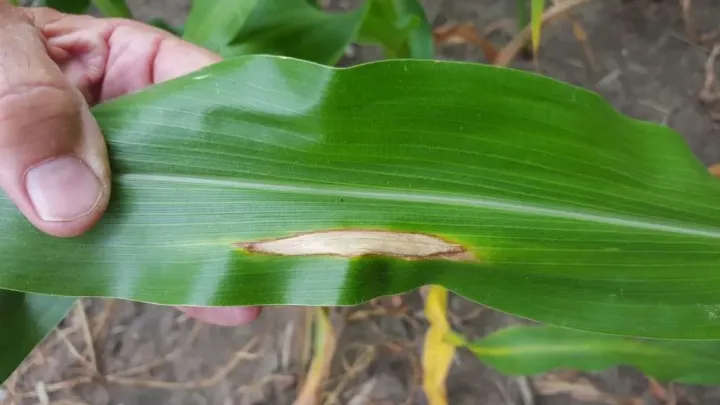
The symptoms typically appear on the lower leaves first. They manifest as long, elliptical or "cigar-shaped" lesions that are greyish-green to tan in color.
As the disease progresses, lesions can grow up to 15 cm in length. These spots often merge to cover large areas of the leaf, leading to extensive tissue death.
Under high humidity, a dark olive-green or black velvety fungal growth appears on the underside of the leaf within the necrotic lesion area.
Severely infected leaves eventually wither and die, often appearing "burned." This leads to a significant loss of green tissue required for grain filling.
In susceptible hybrids, lesions can develop rapidly, appearing on the upper leaves before the corn reaches the silking stage.
Pathogen
The causal agent of Northern corn leaf blight (NCLB) is the fungus Exserohilum turcicum. It is a highly destructive pathogen that specifically affects maize and related species.
The pathogen overwinters primarily in infected crop residue left on the soil surface. During the growing season, wind and rain splash facilitate the dispersal of fungal spores (conidia) to healthy leaves.
The fungus develops optimal biological activity in humid conditions. Its life cycle involves repeated cycles of infection throughout the growing season if weather remains favorable.
The pathogen produces toxins that facilitate tissue necrosis. As the mycelium colonizes the leaf tissue, it disrupts the plant's ability to maintain efficient physiological functions.
Genetic diversity within the Exserohilum turcicum population is significant, which allows the fungus to overcome certain host resistance genes over time.
Conditions for development
Northern corn leaf blight thrives in moderate temperatures ranging from 18 to 27 degrees Celsius, accompanied by prolonged periods of leaf wetness.
High relative humidity, dew, and frequent rain events are critical for spore germination and successful penetration of the leaf tissue.
Fields with high levels of surface crop residue serve as a major primary source of inoculum, especially in no-till or reduced-tillage systems.
Dense planting configurations reduce airflow and promote extended leaf wetness, which significantly increases the severity of the outbreak.
Extended cloudy, wet weather during the mid-to-late vegetative stages provides the perfect environment for secondary spread across the canopy.
Why it matters
The primary damage is caused by the loss of photosynthetic leaf area, which reduces the plant's capacity to produce carbohydrates for grain development.
Economic losses can be substantial, often exceeding 30–50 percent of potential yield in susceptible hybrids under severe epidemic conditions.
Besides yield reduction, the disease weakens the stalk, making the corn more susceptible to lodging and stalk rot, which complicates harvesting operations.
The quality of grain is also impacted, often resulting in lower test weights and increased susceptibility to other ear-rotting fungi.
In cases of early-season infection, the crop may suffer from significant developmental delays and stunted plant growth.
Protection
The most effective strategy for managing NCLB is the use of resistant or tolerant corn hybrids. Breeders continue to introduce new resistance genes to manage the disease.
Effective crop rotation is essential to break the cycle of the disease, as it reduces the amount of primary inoculum available in the field.
Tillage practices that bury crop residue help accelerate the decomposition of the infected leaves, thereby reducing the survival of the fungus.
Fungicide applications are highly effective when applied at the appropriate growth stage, typically triggered by the presence of initial lesions.
- Monitor fields regularly, especially during wet weather patterns.
- Use high-quality seed treatments to protect seedlings.
- Manage plant density to optimize airflow and humidity within the canopy.
- Ensure balanced fertilization to keep plants vigorous and resilient.
Pathogens and affected parts
Affects crops · 1
Discussion
No discussions yet — be the first.