
Description
Symptoms
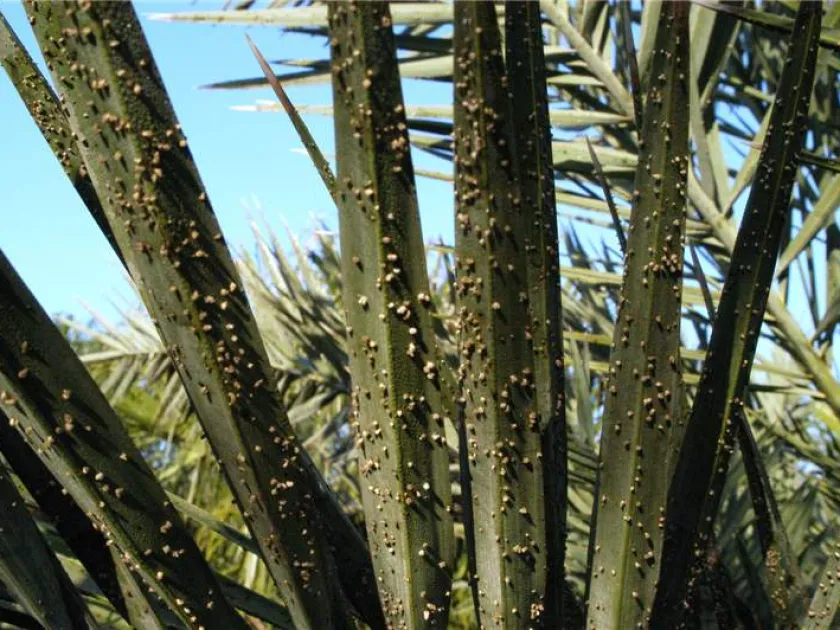
The initial sign of the disease is the appearance of small, hard, dark spots, about 1–3 mm in diameter, on both sides of the leaf blades. These are the spore-producing structures of the fungus.
The center of these spots often turns lighter in color, while the edges may become yellowish or brown as the spores mature. The affected tissue becomes brittle and eventually dies off.
In many cases, the infection presents as a dense rash that gives the leaves a dusty or granular appearance. This drastically reduces the ornamental value of the palm.
As the infection progresses, the leaves turn yellow, dry out prematurely, and fall off. This defoliation typically starts from the lower, older parts of the canopy and moves upwards.
A key diagnostic feature is the presence of these characteristic spots on older leaves, helping distinguish Graphiola from other bacterial or fungal palm pathogens.
Pathogen
Graphiola leaf spot is a fungal disease caused by the pathogen Graphiola phoenicis. This fungus belongs to the Exobasidiomycetes class and specifically targets various palm species, including date and coconut palms.
The organism primarily infects older leaves, penetrating the epidermal tissues. Throughout its lifecycle, the fungus forms small, dark, wart-like fruiting bodies that are easily visible on the leaf surface.
The pathogen's lifecycle is closely tied to environmental moisture, making it highly prevalent in humid subtropical and tropical regions. Spores are easily disseminated by wind and water splashes to healthy leaves.
The fungus can survive in plant debris, necessitating rigorous sanitary maintenance of the site. The incubation period is often asymptomatic, hiding the infection until visible signs appear.
The biology of the pathogen is adapted to extracting nutrients from the plant host, leading to a depletion of the palm's metabolic reserves. Without intervention, colonies can cover the entire leaf, obstructing photosynthesis.
Conditions for development
High relative humidity is the primary driver for the development of Graphiola leaf spot. The disease spreads most aggressively during periods of prolonged rainfall or when overhead irrigation is used.
Poor air circulation within the palm canopy creates an ideal microclimate for fungal spore germination. Overcrowded planting densities significantly increase the risk of an outbreak.
Temperatures ranging from 20 to 28 degrees Celsius are optimal for mycelial growth. Under these conditions, the sporulation rate is maximized.
The presence of free water on leaf surfaces is necessary for successful infection. If leaves remain dry, the probability of the fungus establishing itself on the tissue is significantly reduced.
Improper horticultural practices, such as excessive nitrogen fertilization, result in softer plant tissues that are more susceptible to pathogen penetration.
Why it matters
The main damage caused by this disease is the disruption of photosynthesis due to the infection of large leaf areas. This results in stunted growth and a decline in overall plant vigor.
Severe infection weakens the palm's immune system, making it more vulnerable to secondary pests and additional pathogens. Date and coconut palms lose their aesthetic appeal and commercial value.
If left untreated, the palm can lose its entire canopy, eventually leading to the death of the tree. In commercial plantations, the disease significantly reduces fruit yields.
The infection spreads rapidly between individual plants, which can result in the loss of an entire nursery stock if not managed properly.
Economic losses arise not only from the loss of trees but also from the ongoing costs of fungicide applications and regular sanitation pruning.
Protection
The primary control measure is the timely pruning and destruction of heavily infected leaves. This reduces the inoculum pressure and improves air circulation within the canopy.
- Thinning out palm plantings to enhance air movement.
- Applying copper-based fungicides for preventative spraying.
- Adjusting irrigation methods to avoid wetting the foliage.
- Monitoring and controlling humidity levels in greenhouse environments.
- Regular inspections of lower leaf tiers for early detection.
Systemic fungicides are effective during the early stages of the disease. Treatments should be repeated according to label instructions, rotating active ingredients to prevent fungicide resistance.
Ensuring balanced mineral nutrition is crucial, as a healthy, vigorous plant is better able to resist fungal infections.
If the disease is detected in a nursery, infected plants must be isolated from healthy ones, and the area must be thoroughly disinfected.
Pathogens and affected parts
Affects crops · 2
Discussion
No discussions yet — be the first.