

Disease · fungal · affects Common sunflower, Jerusalem artichoke, Maize
Fusarium stalk rot
Gibberella
Description
Symptoms
Visible symptoms often emerge during the grain-filling stage. The first sign is typically the yellowing and premature wilting of leaves, which often starts from the bottom of the plant and works upward.
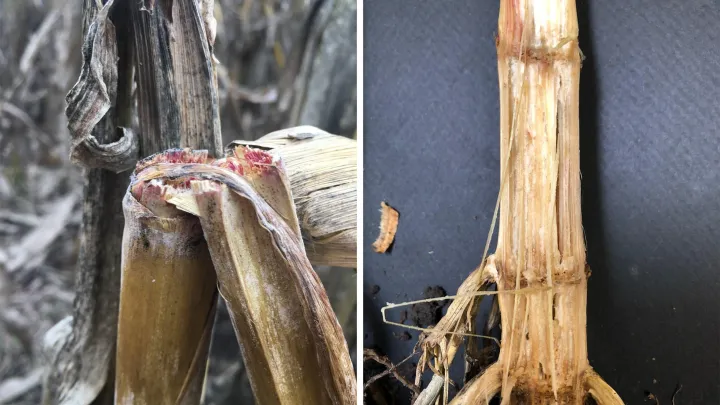
When the stem is sliced open, the internal pith tissue shows clear signs of browning or necrosis. In advanced stages, the internal stem tissue becomes hollowed out and filled with a fluffy, white or pinkish fungal mycelium.
The stems of affected plants become brittle and weakened, leading to lodging, where plants bend or snap near the base under their own weight or when subjected to moderate wind.
External stem surfaces may show dark, discolored patches. Under high humidity, a fungal bloom, which appears as a dusty pink or white layer, may be visible at the nodes or surface lesions.
The root system may also show signs of decay or reddish discoloration, confirming that the pathogen is systemic and has severely compromised the plant's structural integrity.
Pathogen
Fusarium stalk rot is caused by several species of fungi within the Fusarium genus, notably Fusarium moniliforme, whose sexual stage is identified as Gibberella fujikuroi. This pathogen is a common soil-borne fungus that survives in crop debris and the soil for several years.
The disease affects a wide range of agricultural crops, most notably sunflower, Jerusalem artichoke, and maize. Infection typically begins when fungal spores enter through the roots or wounds in the lower stem.
Once inside, the fungus colonizes the vascular tissues, effectively disrupting the plant's ability to transport water and essential nutrients from the roots to the leaves and developing reproductive parts.
Reproduction occurs via conidia, which are easily dispersed by wind, rain splashes, or insect vectors, leading to the rapid spread of the disease within and between fields.
The high genetic variability of Fusarium species makes the pathogen resilient, allowing it to adapt to various environmental conditions and making it a persistent challenge for farmers.
Conditions for development
The development of the disease is most favorable under conditions of high soil and air humidity, with temperatures ranging from +20°C to +28°C. Fluctuations in temperature can exacerbate the stress on plants.
High planting density restricts airflow between plants, creating a damp, stagnant microclimate that is ideal for the germination and spread of fungal spores.
Nutrient imbalances, particularly excessive nitrogen fertilization that promotes rapid, lush growth, can make plant tissues softer and more susceptible to invasion by the fungus.
Wounds caused by insect feeding, such as stem borers or other pests, act as entry points for the pathogen, significantly increasing the probability of severe infection.
Continuous cropping of susceptible species on the same field leads to a massive accumulation of inoculum in the soil, which drastically increases the pressure of the disease.
Why it matters
The primary economic impact of Fusarium stalk rot is the reduction in yield. Because the vascular system is damaged, the plant cannot properly fill ears of corn or sunflower heads, resulting in small or shriveled grains.
Premature death of the plants prevents them from reaching full maturity, leading to a significant loss in both total weight and overall quality of the harvested produce.
Lodging caused by the disease creates major logistical challenges during harvest, as fallen plants are often missed by mechanical harvesters, leading to further yield losses.
Certain Fusarium species produce mycotoxins that are harmful to humans and livestock. The presence of these toxins can render grain unfit for consumption and lead to the rejection of the entire harvest.
In severe outbreaks, the cumulative effect of reduced plant vigor, poor grain development, and harvest losses can result in damage of up to 30–50% of the potential crop yield.
Protection
Crop rotation is the most effective cultural practice to manage the disease. Planting non-host crops for a period of several years helps to deplete the population of the pathogen in the soil.
Tillage practices that promote the burial and rapid decomposition of crop residues are essential, as these residues serve as the primary reservoir for the fungus.
Seed treatment using high-quality systemic fungicides is a crucial proactive measure, protecting the seedling during the early stages of growth when it is most vulnerable.
Balanced fertilization, particularly ensuring adequate potassium and phosphorus levels, strengthens plant tissues and improves the crop's natural resistance to infection.
Integrated pest management strategies are vital to minimize insect-related stem damage, as preventing physical trauma to the plants serves as a primary defense against fungal entry.
In brief
3
Affects crops
Biology
Pathogens and affected parts
Pathogens
Gibberella· fungus
Nirenberg· fungus
Toussoun· fungus
Gibberella subglutinans· fungus
Gibberella fujikuroi· fungus
Gibberella moniliformis· fungus
Gibberella acuminata· fungus
Gibberella intricans· fungus
Nectria haematococca· fungus
Plectosphaerella tabacinum· fungus
Microdochium tabacinum· fungus
Monographella cucumerina· fungus
Affected plant parts
stem
Content graph
Affects crops · 3
Content graph
Connections · Fusarium stalk rot
Most often together:
Marketplace
Products · 3
Community
Discussion
No discussions yet — be the first.