
Disease · fungal · affects Banana, Maize, Winter barley
Helminthosporium leaf spot
Dreschslera gigantea
Description
Symptoms
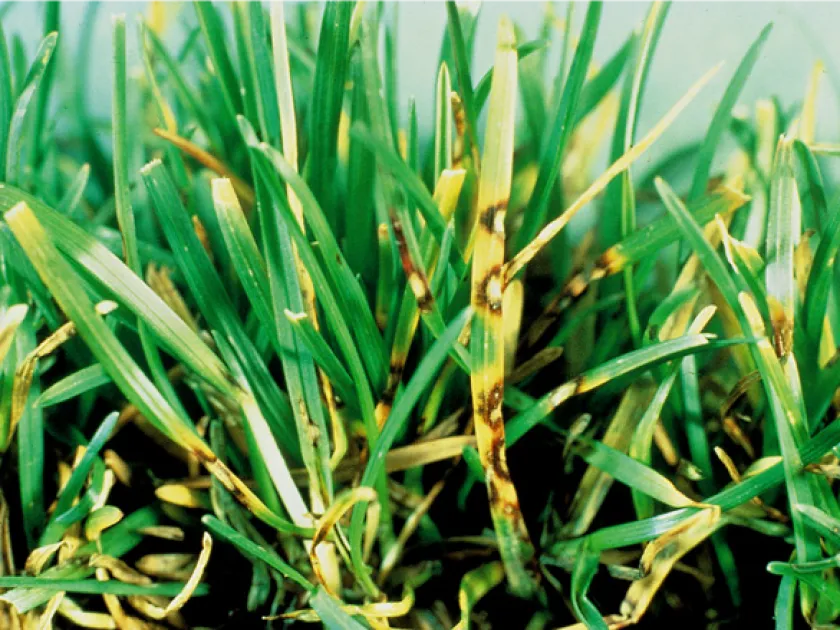
Symptoms typically appear as small, chlorotic flecks that expand into elongated, oval, or spindle-shaped lesions. These spots often feature a tan to gray necrotic center surrounded by a dark brown or black margin.
Under humid conditions, the centers of the lesions produce a visible, dark olive-colored sporulation layer, which is a diagnostic feature used to identify the fungal presence.
Extensive lesion development often leads to the coalescence of spots, causing large sections of the leaf blade to wither, curl, and die prematurely.
In cases of severe infection, stem-base lesions may occur, resulting in weakening of the stalks and susceptibility to lodging in cereal crops.
In maize, the disease can affect not only the foliage but also the husks of the ears, which affects the overall aesthetic and economic value of the harvest.
Pathogen
The causative agent of this disease is the fungus Dreschslera gigantea (formerly known as Helminthosporium giganteum). It is a filamentous fungus that primarily affects various grass species and cereal crops.
The fungus produces large, multicellular conidia which are disseminated by wind, rain splashes, and farm equipment. It can thrive as a necrotrophic parasite on living tissues and as a saprophyte on decaying plant matter.
Dreschslera gigantea is known to infect winter wheat, barley, maize, and even exotic crops like bananas, making it a pathogen of significant agricultural concern globally.
The survival mechanism involves overwintering in crop residues left on the soil surface, providing a primary inoculum source for the following season's growth.
Genetic studies indicate that the fungus has various strains, some of which show higher virulence towards specific host cultivars, complicating resistance breeding programs.
Conditions for development
The development of Dreschslera gigantea is highly dependent on high moisture levels. Relative humidity above 85% is essential for successful spore germination and penetration.
The disease incidence peaks during periods of warm and wet weather, with optimal temperatures for fungal growth ranging between 20°C and 25°C.
Dense canopies in cereal fields create stagnant air conditions, which elevate humidity levels at the leaf surface and promote rapid secondary infection cycles.
Prolonged leaf wetness, often caused by heavy dew or frequent rainfall, significantly increases the severity of the disease during the vegetative growth stages.
Poor soil fertility and plant stress factors weaken the host's natural defenses, making the crop more susceptible to fungal colonization.
Why it matters
The primary impact of the disease is the substantial reduction of photosynthetic capacity due to massive leaf destruction, which directly limits plant biomass production.
Grain filling is severely compromised, resulting in shriveled kernels, lower test weights, and significantly reduced grain yields per hectare.
In addition to yield loss, the disease may negatively influence the protein quality and nutritional composition of the harvested cereal grains.
Plant lodging induced by weakenened stem structures causes mechanical harvesting difficulties and increases post-harvest grain losses.
For high-value crops like bananas, leaf spot diseases caused by Dreschslera species can cause severe foliage necrosis, leading to stunted fruit development and market rejection.
Protection
Managing the disease requires an integrated approach starting with deep tillage to bury infected crop residues, which hastens the decomposition of the pathogen's substrate.
Implementing a rigorous crop rotation cycle—avoiding consecutive planting of susceptible cereals in the same field—is critical to breaking the disease life cycle.
Foliar application of systemic fungicides, particularly those containing triazoles or strobilurins, provides effective protection when applied at the early stages of symptom appearance.
Selecting resistant cultivars or tolerant hybrids remains the most sustainable method for managing Dreschslera leaf spot in large-scale agricultural production.
- Use of certified, disease-free seed material.
- Balanced fertilization to prevent plant stress.
- Control of volunteer weeds that act as alternate hosts.
- Timely scouting and monitoring of the field.
In brief
4
Affects crops
Biology
Pathogens and affected parts
Pathogens
Dreschslera gigantea· fungus
Pseudocercosoporella herpotrichoides· fungus
Tapesia yallundae· fungus
Kabatiella zeae· fungus
Aureobasidium zeae· fungus
Oculimacula acuformis· fungus
Pseudocercosporella herpotrichoides· fungus
Ramulispora acuformis· fungus
Ramulispora herpotrichoides· fungus
Ramulispora· fungus
Tapesia acuformis· fungus
Oculimacula yallundae· fungus
Affected plant parts
whole plant
Content graph
Affects crops · 4
Content graph
Connections · Helminthosporium leaf spot
Most often together:
Marketplace
Products · 21


Ultrasil Duo t.c.s.
«Ред Сан Груп Корпорейшн, Лтд.,Китай
Fungicides
0
0
·
65
5 offers
2.91 €per 1 l
Buy


Kompozit SSk.s.
Nanjing No.1 Pesticide Factory of Red Sun Group Co., Ltd.
Fungicides
0
0
·
34
1 offer
24 €per 1 l
Buy


Spiral
China National Chemical Construction Ningbo Import & Export Co.
Fungicides
0
0
·
61
No offers
—
Details


Community
Discussion
No discussions yet — be the first.