
Tufted vetch
Vicia cracca L. subsp. cracca
Description
Sowing dates
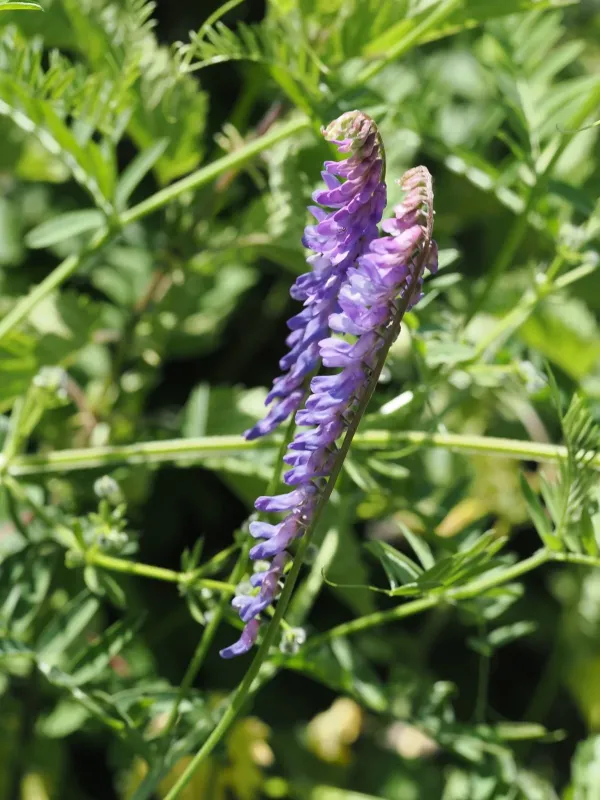
Tufted vetch is a perennial herbaceous plant belonging to the Fabaceae family. In agricultural settings, it is valued as a hardy forage crop often mixed with other grasses.
The ideal time for planting is early spring, as soon as the soil can be worked. Late autumn sowing is also practiced in regions with mild winters to ensure early germination.
The seeding rate typically ranges from 15 to 25 kilograms per hectare, depending on whether it is sown as a pure stand or as part of a seed mixture.
Proper seedbed preparation is essential; seeds should be sown at a depth of 2 to 4 centimeters. Ensuring good soil-to-seed contact significantly improves the emergence rate.
Once established, the crop develops a dense mat of vegetation that effectively suppresses weeds and prevents topsoil erosion in fields or meadows.
Growing requirements
Tufted vetch is highly adaptable to various climatic conditions, demonstrating excellent winter hardiness. It thrives in temperate regions across the globe.
The plant prefers well-drained loam or sandy loam soils but shows a remarkable tolerance for various soil types, provided they are not waterlogged for extended periods.
Like many legumes, it forms a symbiotic relationship with nitrogen-fixing bacteria, which allows it to thrive in nutrient-poor soils by enriching them with nitrogen.
Although it can tolerate partial shade, it achieves its maximum biomass production when grown in full sun, where its development is rapid and robust.
While drought-resistant, the plant benefits from adequate moisture during the early vegetative stage to establish a deep and efficient root system.
Yield
As a forage crop, tufted vetch is highly esteemed for its high protein content. It provides excellent nutritional value for livestock, whether fed as fresh green forage or preserved as hay.
Average yields vary depending on environmental factors and soil fertility, but farmers can typically expect 10 to 20 tons of fresh biomass per hectare per harvest.
Its role as a green manure crop is also significant, as it adds substantial amounts of organic matter and nitrogen back into the soil, benefiting future crops.
It serves as an excellent honey plant, with long flowering periods that support local pollinator populations throughout the summer season.
Proper management of the cutting schedule ensures high nutritional quality, as protein levels are highest just before the full bloom stage.
Main diseases and pests
The crop is susceptible to fungal diseases such as powdery mildew and rust, especially during seasons characterized by high humidity and poor air circulation.
Pests like the vetch bruchid and various leaf-eating beetles can reduce yields, particularly when they attack the plant during its flowering and seed-setting phases.
To manage threats effectively, integrated pest management practices should be employed, prioritizing crop rotation to break the life cycles of specific pests.
Maintaining a healthy, well-fertilized field helps the plants develop better resistance to stress and reduces the impact of minor disease outbreaks.
If chemical control is necessary, it must be timed carefully to avoid harm to bees and other beneficial insects that frequent the crop.
Harvesting
Harvesting for fodder should ideally occur at the beginning of the flowering stage to capture the best balance of biomass and protein density.
When producing hay, careful drying and turning are required to preserve the nutrient-rich leaves, which are prone to shattering if over-dried.
For seed production, the harvest should be timed when the majority of the pods have turned brown to minimize losses from pod shattering during mechanical harvesting.
Using modern harvesting equipment with precise settings helps maintain the integrity of the crop and ensures minimal loss of quality during the process.
Post-harvest management should include soil aeration to help incorporate the remaining organic matter and prepare the field for the next growth cycle.