
Festuca gautieri
Festuca gautieri (Hack.) K. Richt.
Description
Growing requirements
Festuca gautieri, commonly known as Bearskin fescue, is a perennial grass species belonging to the Poaceae family. Originating from the mountain ranges of Southwestern Europe, particularly the Pyrenees, it is highly adapted to rocky and alpine environments.
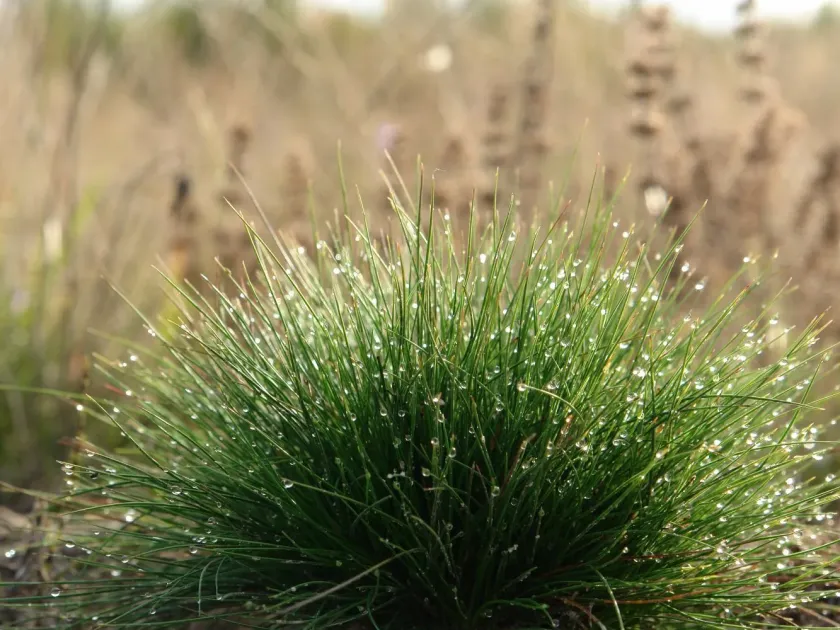
The plant is characterized by its exceptionally dense, needle-like foliage that grows in compact, cushion-like mounds. These cushions typically reach a height of 10 to 15 centimeters and display a vivid green color throughout the growing season.
This species requires well-drained, sandy or gravelly soils to thrive. It is highly intolerant of waterlogged conditions, which can lead to rapid root decay. Poor drainage is the most common reason for failure in cultivating this specific ornamental grass.
Full sun is essential for Festuca gautieri to maintain its characteristic compact, mounded shape. While it can survive in partial shade, the plant will likely lose its density and structural integrity, becoming sparse and less aesthetically appealing over time.
In terms of usage, it is highly valued in rock gardens, alpine displays, and as a low-maintenance ground cover. Its ability to tolerate dry conditions and poor soil makes it a resilient choice for sustainable landscaping projects in suitable climates.
Main diseases and pests
The most significant threat to the health of Festuca gautieri is root rot caused by poor soil drainage. Maintaining a dry root environment, especially during winter months, is critical for preventing the collapse of the plant's dense center.
Fungal diseases, including rust, can occur if the plant is subjected to high humidity and poor air circulation. To mitigate this risk, it is important to space plants appropriately and avoid watering overhead, which keeps the foliage unnecessarily moist.
Pests such as spider mites may become a problem during periods of intense heat and drought. Regular inspection and the use of appropriate miticides can control infestations before they cause significant damage to the needle-like leaves.
Over-fertilization should be strictly avoided as it encourages rapid, weak growth that is more susceptible to environmental stress and disease. The plant performs best in lean soils where it can develop a hardy and compact root system.
Regular maintenance, including the removal of dead foliage from the center of the mound, is necessary to improve airflow. This practice not only preserves the plant's decorative appearance but also reduces the likelihood of moisture-related infections.