
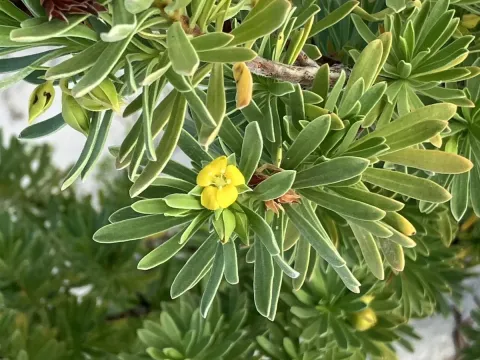
Bay cedar
Suriana
Bay cedar (Suriana maritima) is a distinctive evergreen shrub belonging to the monotypic genus of the Surianaceae family. It is widely recognized for its ecological importance in tropical and subtropical coastal zones around the globe.
What the section contains

Bay cedar
The plant exhibits remarkable adaptation to harsh marine environments, being highly salt-tolerant and capable of thriving in sandy, limestone, or coral-based soils that are deficient in traditional nutrients.
In terms of climate, Bay cedar requires full sun exposure and consistent high temperatures. It lacks frost tolerance, which restricts its natural and cultivated range to tropical and warm maritime climates where the risk of freezing is non-existent.
Agricultural practices for this species focus on maintaining soil aeration and ensuring that the plants are protected from waterlogging. The root system is evolutionarily designed to extract moisture from well-drained porous substrates.
Due to its dense and durable structure, the plant serves as a vital natural barrier against wind erosion. Its presence in the coastal landscape is essential for stabilizing dunes and preventing sand shifting during storm events.
Bay cedar is not a crop cultivated for edible or industrial harvest. Its management revolves around conservation efforts and its utilization in sustainable landscaping projects aimed at restoring coastal ecosystems.
Nursery operations involve the collection of seeds for propagation, which are then used in environmental restoration programs to re-establish vegetation on damaged shoreline areas and coastal embankments.
From a landscape management perspective, routine pruning is performed to improve the aesthetic architecture of the shrub, encouraging denser foliage growth and better resistance against strong winds.
While the wood is historically documented as being quite hard, it is not subject to organized harvesting. Current environmental policies emphasize the protection of wild populations rather than the exploitation of the shrub's physical resources.
Monitoring for health involves regular checks after extreme weather events, ensuring that the salt-spray balance is maintained and that the root systems remain properly anchored in the sandy substrates.