
Bay cedar
Suriana maritima
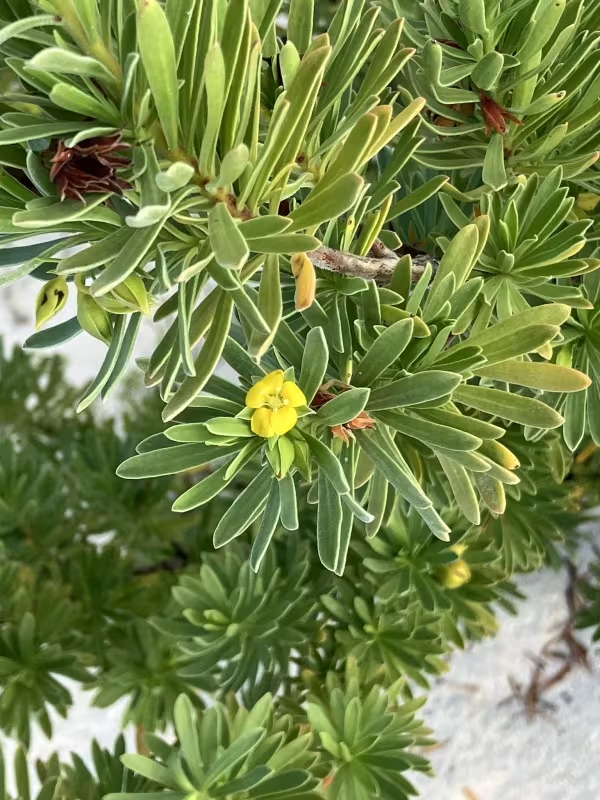
Description
Growing requirements
Bay cedar (Suriana maritima) is a distinctive shrub belonging to the Surianaceae family. It is recognized as a hardy pioneer species, highly adapted to maritime environments and saline soils that would be hostile to most agricultural crops.
The plant originates from the tropical and subtropical regions of the world, specifically found along coral coasts and sandy dunes. Its evolutionary adaptations include specialized leaf structures that help mitigate the effects of extreme salinity and high sunlight.
Regarding soil requirements, the plant thrives in calcareous sands and limestone substrates. It demands excellent drainage and cannot tolerate waterlogged conditions, making it unsuitable for standard agricultural fields but perfect for coastal management.
Climatic requirements are centered around high temperatures and constant sun exposure. Bay cedar is frost-intolerant, which restricts its cultivation primarily to tropical and warm subtropical climate zones.
Botanically, it features small, succulent-like leaves covered in fine hairs to reduce transpiration. The plant produces small, bright yellow flowers, adding to its ecological significance as a nectar source for local insect populations.
Harvesting
In terms of хозяйственное использование, Bay cedar is primarily utilized for coastal stabilization and erosion control. Its robust root system anchors loose sand, protecting shorelines from degradation caused by wind and water.
While the wood is known for its extreme density and durability, the shrub's slow growth habit makes it impractical for timber production. Occasionally, local craftsmen use the wood for small decorative items due to its hardness.
In the context of restoration ecology, planting Bay cedar is a standard practice for dune rehabilitation. It creates a microclimate that allows other less salt-tolerant species to eventually colonize the area.
Propagation is typically managed through seeds or stem cuttings. Seedlings require careful monitoring during their initial development to ensure they successfully establish their root networks in shifting sands.
No major commercial pests or diseases are known to threaten widespread populations, as the plant's high salt content in tissues serves as a natural defense mechanism against many common herbivores.