
Blackbrush
Coleogyne ramosissima
Description
Growing requirements
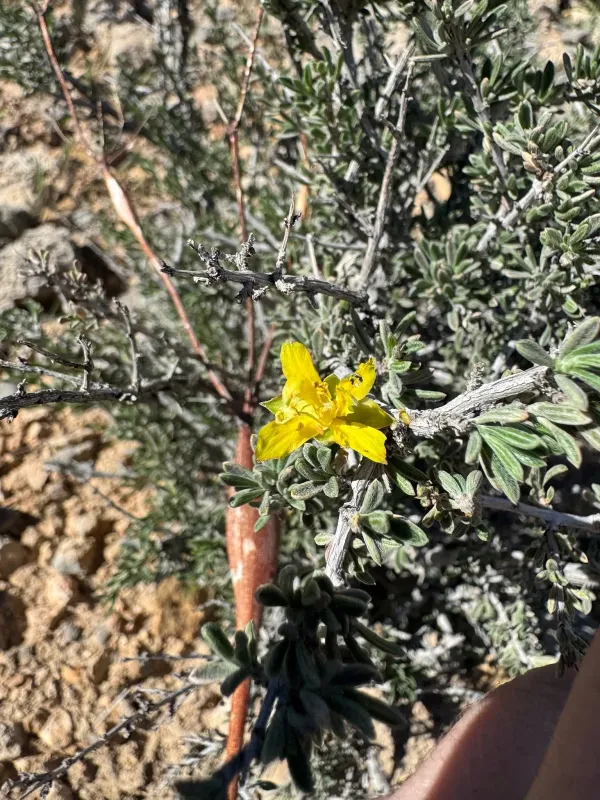
Blackbrush (Coleogyne ramosissima) is a hardy shrub belonging to the Rosaceae family. It is the sole member of its genus and is native to the Mojave and Colorado deserts of the southwestern United States, where it often forms dense, uniform stands.
The plant is highly adapted to arid environments, favoring well-drained, coarse-textured soils including rocky outcrops and alluvial fans. It is characterized by slow growth, sometimes taking several decades to reach maturity in harsh desert conditions.
Agricultural and ecological requirements for blackbrush are strict. It demands high levels of solar exposure and cannot tolerate saline or waterlogged soils. Its root system is exceptionally deep, which allows it to tap into moisture reserves inaccessible to other desert flora.
Climate tolerance includes extreme heat and seasonal drought. The plant enters a state of dormancy to survive the hottest periods, and its stiff, woody stems are specifically evolved to minimize moisture loss through transpiration.
Propagation is primarily through seeds, which require specific environmental cues to germinate. These cues are often linked to a precise sequence of temperature fluctuations and moisture cycles typical of the high-desert spring season.
Main diseases and pests
The primary threat to blackbrush populations is the invasion of non-native grasses, particularly cheatgrass (Bromus tectorum). These grasses provide fine fuel that increases the frequency and intensity of wildfires, to which blackbrush is poorly adapted.
While mature plants are resistant to most herbivores due to high levels of tannins and phenolic compounds, they are vulnerable to overgrazing during periods of extreme drought when other forage is unavailable, leading to significant plant mortality.
Fungal pathogens associated with root rot represent the main internal health threat. This is exacerbated by improper irrigation in cultivation environments where drainage is not prioritized or soil moisture is kept too high for extended periods.
Insects and pests, while generally not devastating, can impact seedling survival. Larvae of certain specialized beetles may feed on the foliage or burrow into the stems, weakening younger, less established individuals.
The reduction of naturally occurring rainfall cycles poses a significant long-term threat. As a species reliant on episodic recruitment, any disruption in the timing of annual precipitation cycles directly impedes the ability of the species to regenerate its populations.