
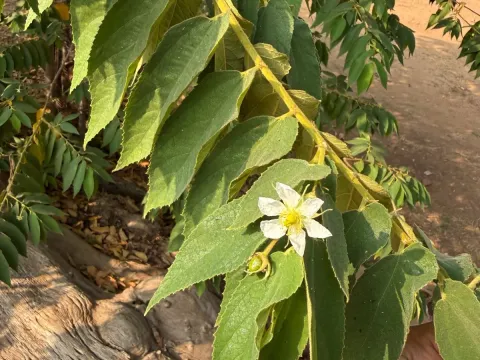
Muntingia
Muntingia
Muntingia (Muntingia calabura) is typically propagated via seeds or cuttings. The seeds are extremely small, so they should be sown on the surface of well-drained, moist soil without being buried too deep.
What the section contains

Muntingia
Germination requires consistently warm temperatures, ranging from 25 to 30 degrees Celsius. It is essential to maintain constant soil moisture while avoiding waterlogging, which can cause the delicate seedlings to rot.
Seedlings exhibit rapid growth, showing significant development within the first few months. When transplanting to a permanent location, care must be taken to minimize root system damage, as young plants are sensitive to disturbances.
Propagation by cuttings allows for faster fruit production and ensures that the new plant retains the desirable characteristics of the parent. Cuttings should be taken from semi-hardwood shoots and rooted in a greenhouse with high humidity.
Planting in open ground should only occur after all risks of frost have passed, as the species is highly sensitive to cold temperatures and requires a frost-free environment.
Muntingia belongs to the Muntingiaceae family and is a characteristic plant of tropical ecosystems. It thrives in open, sunny locations where it can receive maximum solar exposure for vigorous growth.
The culture is undemanding regarding soil type, adapting well to poor, sandy, or even rocky soils. However, optimal development occurs in deep, fertile loams with a neutral to slightly acidic pH.
The tree exhibits exceptional drought tolerance, allowing it to survive during extended dry seasons. Nevertheless, for high fruit yields, regular irrigation during active growing periods is highly recommended.
An ideal climate for Muntingia is tropical, characterized by minimal seasonal temperature fluctuations. Because it cannot tolerate freezing temperatures, it is grown in temperate regions exclusively in greenhouses or as a container plant.
Effective management requires providing sufficient space for the wide, spreading canopy, as the tree grows rapidly and can reach a considerable size in a very short amount of time.
A primary commercial advantage of Muntingia is its ability to produce fruit almost continuously in favorable tropical conditions. The tree typically begins to bear fruit within two to three years of planting.
The fruit consists of small, rounded berries that turn bright red or yellow when ripe. They have a sweet, musky flavor often compared to a blend of strawberry and fig, which is highly appreciated locally.
The yield of a mature tree is remarkably high, with a single plant producing tens of kilograms of berries annually. This makes it a promising crop for commercial cultivation in suitable geographic regions.
The fruits are extremely delicate and have a very short shelf life, making long-distance transportation challenging. Consequently, consumption is focused on local markets or home-based processing.
In addition to the fruits, the tree provides high-quality fiber from its bark, which is used locally for weaving and rope making, further increasing its economic and agricultural utility.
Muntingia is generally resilient, but in high-humidity conditions with poor airflow, it can be susceptible to fungal leaf diseases. Regular pruning helps to improve air circulation and mitigate infection risks.
Among pests, scale insects and spider mites are the most common threats, often colonizing the shoots. Management involves the application of appropriate insecticides and maintaining strict garden hygiene.
Improper irrigation causing water stagnation in the root zone frequently leads to root rot, manifesting in canopy wilting and potential plant death. Providing high-quality drainage is a critical factor for tree health.
Damage caused by certain wood-boring insects can weaken the trunk, making the tree vulnerable to wind breakage. Monitoring bark condition allows for early detection and localization of any infestations.
Avoid excessive application of nitrogen fertilizers, as this promotes vegetative growth at the expense of fruit production and can make the tree more attractive to sap-sucking pests.
Harvesting Muntingia requires frequent attention, as the berries ripen unevenly and tend to drop quickly once fully mature. During peak season, daily harvesting is often necessary.
The degree of ripeness is determined by the intensity of the skin color and the softness of the fruit. Under-ripe berries are acidic, while over-ripe ones become excessively soft and lose their commercial appeal.
Hand picking is the only effective method due to the fruit's fragility. Using soft containers or baskets during collection is essential to minimize bruising and damage during transport.
Harvested fruit should be sold or processed within 24 hours. The berries are excellent for making jams, jellies, and preserves, and are commonly used in desserts and baked goods.
Harvesting from tall trees requires the use of ladders and careful handling, as the branches can be surprisingly brittle and prone to breaking under weight.