
Allseed
Radiola linoides
Description
Growing requirements
Radiola linoides, commonly known as allseed, is a diminutive annual plant belonging to the flax family, Linaceae. It is not cultivated as a commercial agricultural crop, but rather studied in botany as a specialized species adapted to specific moisture-rich environments.
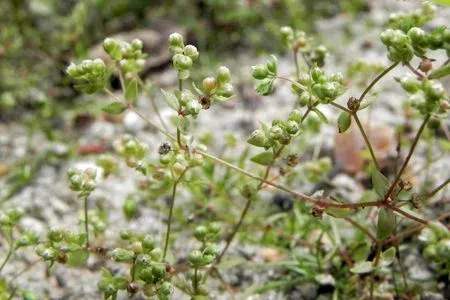
Botanically, the plant is characterized by its extremely small size, usually reaching only a few centimeters in height. It features dichotomously branched stems and tiny, opposite leaves, which are typical adaptations for this ephemeral species inhabiting open, damp landscapes.
The native range of the species extends across Europe and parts of North Africa and Western Asia. It thrives in transiently moist habitats, such as damp sandy tracks, muddy shores of ponds, and areas where vegetation cover is sparse due to environmental stress.
Regarding growth requirements, allseed is highly dependent on sufficient soil moisture and high light availability. It lacks the competitive ability to thrive in dense vegetation, which is why it is strictly confined to disturbed or ecologically unique sites where competition is minimal.
There are no economic or agricultural applications for Radiola linoides. Because of its microscopic size and lack of biomass or useful chemical properties, it remains purely a subject of interest for field botany and ecological studies rather than a crop for modern farming practices.