
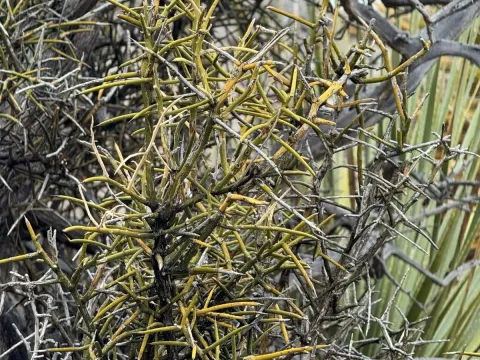
Koeberlinia
Koeberlinia
Koeberlinia (Koeberlinia spinosa) is a unique leafless shrub that represents the monotypic family Koeberliniaceae. In its natural habitat, it is adapted to the extreme conditions of arid regions.
What the section contains

Koeberlinia
The plant originates from the southwestern United States and northern Mexico, where it grows in semi-desert environments and arid plateaus. It prefers well-drained sandy or rocky soils with low organic content.
Koeberlinia possesses a high tolerance for intense sunlight and moisture deficiency. Its photosynthesis occurs directly in the green stems, which is an evolutionary survival strategy in desert climates.
For the development of this species, the absence of water stagnation in the root zone is critical. The plant is capable of enduring long periods of extreme heat characteristic of the Sonoran and Chihuahuan deserts.
Agrotechnically, the crop requires minimal intervention as it is adapted to soils with high alkalinity and salinity, where other types of vegetation cannot survive.
The main risk factors for Koeberlinia are fungal diseases of the root system, which arise exclusively during artificial over-watering of the soil.
Pests that typically attack agricultural crops do not cause significant damage to Koeberlinia due to the rigid structure of its woody stems.
A serious threat to the population is posed by abrupt changes in the hydrological regime of the territory, leading to soil erosion.
Despite high levels of natural protection, young shoots can be damaged by specific species of desert aphids during unusually wet spring months.
Effective crop protection is based on strict moisture control and the minimization of any mechanical impact on the branched root system.