
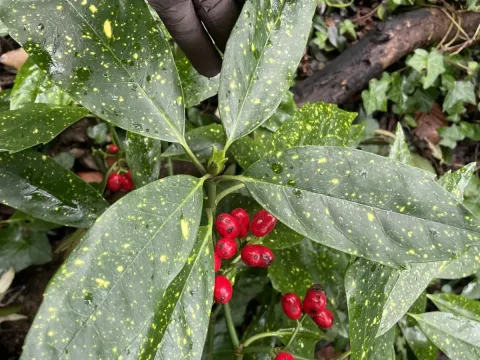
Aucuba
Aucuba Thunb.
Aucuba (Aucuba Thunb.) is a genus of evergreen shrubs belonging to the family Garryaceae. These plants are native to the subtropical forests of East Asia, widely distributed throughout Japan, China, and the Himalayas.
What the section contains

Aucuba
The plant thrives best in partial shade to full shade, as intense sunlight can scorch its glossy foliage. It is moderately hardy, preferring cool temperatures for optimal growth, usually between 18–22 °C, while requiring a cooler dormant phase in winter.
Soil requirements for Aucuba focus on drainage and organic content. A well-aerated, fertile loam with a slightly acidic to neutral pH is ideal to prevent root rot, which is a common issue in heavy, waterlogged soils.
Botanically, it is known for its leathery, often variegated leaves and dioecious nature, meaning male and female flowers are borne on separate plants. When pollinated, female plants produce striking red berries that persist through winter.
In landscaping, Aucuba is primarily used as an ornamental shrub for low-light gardens or as an indoor container plant. Its ability to tolerate air pollution and deep shade makes it highly valued in urban environments.
Key pests include spider mites, scale insects, and mealybugs, which are particularly problematic in dry or indoor environments where natural predators are absent.
Common diseases involve leaf spot caused by fungal pathogens and root rot, which typically stems from overwatering or inadequate soil drainage, leading to poor root respiration.