
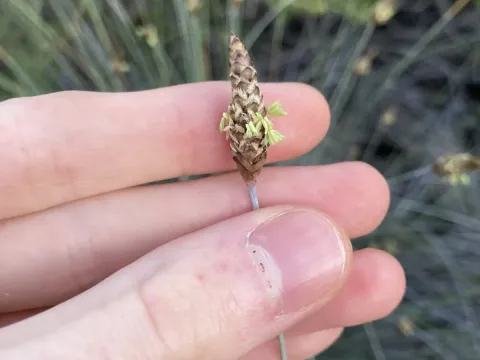
Ecdeiocolea
Ecdeiocolea
Ecdeiocolea is not a traditional commercial crop, and therefore, there are no established agricultural protocols for sowing or industrial cultivation.
What the section contains

Ecdeiocolea
In its native environment, the plant reproduces via seeds, which are adapted to the harsh conditions of the Australian landscape and germinate after specific climate cues.
Experimental cultivation suggests that seeds should be sown during the warmer season when soil temperatures are consistently high to promote germination.
The sowing depth must be kept minimal, allowing the small seeds to receive sufficient light, which is often a critical factor for the emergence of such species.
Pre-treatment of seeds, such as smoke treatment or hydration cycles, may be necessary to overcome natural dormancy mechanisms inherent to this genus.
The genus belongs to the Ecdeiocoleaceae family, a small group of plants that are highly specialized to specific environmental conditions.
The species is endemic to southwestern Australia, thriving in nutrient-poor, sandy soils that are characteristic of the regional heathlands and scrub.
As a xerophyte, Ecdeiocolea exhibits remarkable physiological adaptations to drought, allowing it to survive long periods without significant rainfall.
The primary soil requirement is excellent drainage; the roots are highly susceptible to rot if exposed to waterlogged conditions or poor air circulation.
It requires high levels of solar radiation, making it unsuitable for shaded areas and favoring the open, sun-drenched landscapes of its natural habitat.
There are no recorded yield data for Ecdeiocolea, as the plant currently lacks any industrial or large-scale agricultural purpose.
The plant's biomass production is relatively slow, consistent with many slow-growing, resilient perennial species found in Mediterranean-type ecosystems.
Due to the high fiber content and structural toughness, the plant is not suitable for use as livestock fodder, as it lacks sufficient nutritional value.
Its primary potential value lies in ecological services, such as soil stabilization and maintenance of biodiversity in fragile environmental zones.
Future research into its genetics may uncover potential applications in plant breeding for drought resistance, but currently, no yield-focused cultivation exists.
The main threats to the plant include habitat destruction due to land clearing, urban expansion, and the negative impacts of invasive species.
Climate change, specifically the alteration of fire regimes and reduced annual precipitation, poses a significant risk to the long-term viability of wild populations.
In cultivated or nursery settings, the plant can be susceptible to root pathogens if the growing medium is kept too damp or lacks proper ventilation.
Herbivory by local insects is a natural component of its ecosystem, but severe infestations can occur if the plant is stressed by environmental factors.
Strict biosecurity measures are recommended for anyone studying or handling this species to prevent the introduction of foreign pathogens to its native territory.
There is no commercial harvest procedure for Ecdeiocolea, as it is not cultivated as an economic commodity or food source.
Seed collection for research or conservation purposes is conducted manually by trained botanists during the peak of the seed-maturation cycle.
If harvesting for vegetation study, the plant material is cut in a way that minimizes damage to the rootstock and ensures future regeneration.
Post-harvest handling involves drying the inflorescences in a controlled environment to ensure that seeds remain viable and free from mold.
All activities involving the collection of wild specimens must strictly adhere to Australian environmental protection laws to prevent illegal exploitation.