
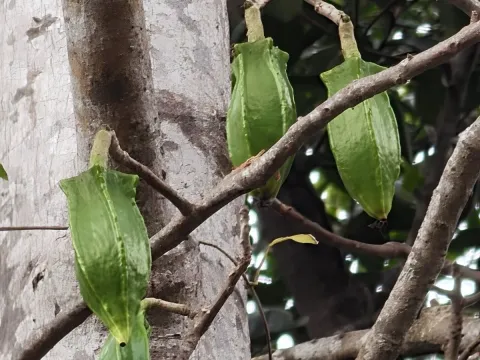
Jacaratia
Jacaratia
Propagation of Jacaratia in natural conditions primarily occurs via seeds. Seeds are extracted from ripe fruits and planted in light, well-draining substrate immediately after cleaning, as they have a low capacity for long-term storage.
What the section contains

Jacaratia
Successful germination requires soil temperatures in the range of +24…+28°C. In nurseries, containers with a nutrient-rich mixture are used to ensure sufficient aeration of the root system during the early development stages.
Seedlings emerge unevenly, usually within 3 to 6 weeks. After the formation of 3 to 4 true leaves, the seedlings require transplanting into individual containers to prevent damage to the taproot.
For vegetative propagation, the cutting method is used, but it requires strict humidity control and the use of rooting hormones due to the wood's tendency to rot quickly.
Planting saplings in their permanent location in the orchard is carried out at the beginning of the rainy season, allowing the young root system to adapt to soil conditions before the onset of the intense dry period.
Jacaratia belongs to the Caricaceae family and is a typical representative of tropical flora. It requires consistently high temperatures throughout the year and high relative humidity for active vegetative growth.
The plant prefers well-draining, fertile soils with a neutral or slightly acidic pH. Waterlogging in the root zone is detrimental; therefore, on heavy clay soils, the creation of raised beds or drainage systems is essential.
The crop is light-loving, but young plants in their first year require light shading to avoid leaf burns from direct equatorial sun exposure.
The optimal rainfall for commercial cultivation is 1200–1800 mm per year. In regions with a distinct dry season, the organization of regular irrigation is mandatory.
A critical factor is protection from strong winds, as Jacaratia wood is relatively brittle and can be damaged by storm gusts, which reduces the overall productivity of the trees.
Jacaratia fruits are edible berries, often of an elongated or ribbed shape, externally resembling a small papaya. Yield depends on the age of the tree and the lighting conditions within the canopy.
Trees begin to enter the fruiting phase 3–5 years after planting. As the plant matures, the volume of fruit harvested from a single specimen increases significantly.
Harvesting is carried out selectively as the fruits reach technical maturity, when the skin changes its shade to a lighter or yellowish color. Overripe fruits are prone to rapid cracking.
The fruits are used in local cuisine: they are consumed fresh, made into drinks or jams, or used in exotic desserts due to their pleasant taste.
In addition to the fruits, the milky sap of the plant is sometimes used in agriculture, containing enzymes similar to papain, which are applied for tenderizing meat products.
The greatest danger to Jacaratia is fungal root system diseases arising from waterlogged soil. Root rot can lead to the rapid death of the tree.
Among pests, various sucking insects such as aphids and scale insects are notable; they attack young shoots and leaves, significantly reducing the plant's growth rate.
Stem damage can facilitate the entry of secondary infections. It is necessary to avoid mechanical trauma when conducting agricultural activities in the rows.
To prevent the spread of pathogens, it is recommended to maintain a distance between trees when establishing an orchard, ensuring good air circulation within the canopy.
The use of insecticides and fungicides must be strictly dosed and compliant with environmental standards, as many pests develop resistance to chemical agents rapidly.
Harvesting is performed manually using pruning shears or garden knives. It is important to carefully cut the fruit stalk so as not to damage the tree's bark at the attachment point.
Jacaratia fruits have a relatively short shelf life, so they must be transported to a cool, shaded area as quickly as possible after harvest for further processing.
Sorting is carried out immediately after harvest: damaged or pest-affected specimens are discarded to prevent spoilage of the entire batch during transportation.
On a commercial scale, the fruits are packed in ventilated containers that prevent crushing. This is necessary due to the soft consistency of the ripe pulp.
The optimal storage temperature to extend the shelf life is +10…+12°C, which helps delay fermentation processes and maintain the market quality of the produce for several days.