
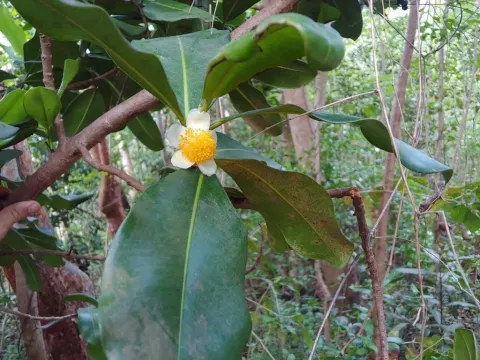
Mammea americana
Mammea
Mammea americana, commonly known as the Mamey apple or tropical apricot, is a large, evergreen tree belonging to the Clusiaceae family. It is valued for its dense foliage and edible, round fruit which features a sweet, orange-colored flesh.
What the section contains

Mammea americana
The tree originates from the tropical regions of the Americas and the Caribbean. It thrives in humid, frost-free environments and is currently cultivated extensively across tropical belts in both hemispheres, often serving as both a food source and an ornamental plant.
To ensure successful growth, the Mamey apple requires deep, fertile, and well-drained soils. While it can adapt to various soil types, it performs best in sandy or loamy soils with a pH that is slightly acidic, provided there is no water stagnation.
The climate must remain consistently warm throughout the year. Mature trees can handle moderate drought conditions, but consistent rainfall or irrigation during the fruiting phase is essential for maximizing both fruit size and yield quality.
Protection from strong winds is crucial, especially during the early stages of establishment. Planting in sheltered locations helps to maintain tree health and prevents the physical damage to branches that can lead to infections or reduced fruit production.
The fruit is used in a variety of culinary applications, including desserts, jellies, and refreshing beverages. Furthermore, the tree's bark and seeds contain compounds that have historically been utilized in traditional medicine and pest control agents.
The crop is occasionally susceptible to infestations by scale insects and mealybugs, which tend to congregate on the underside of leaves. Regular monitoring and the application of horticultural oils are standard practices to keep these pest populations under control.
Fungal issues such as anthracnose can arise during prolonged rainy seasons, leading to leaf spots and fruit rot. Proper pruning to increase airflow within the canopy is the primary agronomic strategy for preventing these disease outbreaks in mature orchards.
Harvesting is performed manually because fruits do not ripen uniformly. Agronomists recommend picking the fruit when the skin transitions from a smooth green texture to a greyish-brown, indicating it has reached the ideal maturity for post-harvest handling.